Background:
Oxford Nanopore Technologies (ONT) third generation sequencing has the benefit of long read-length that allows the efficient and rapid sequencing of long DNA fragments. With the global rollout of integrase strand transfer inhibitors for treatment naïve and treatment experienced patients, drug resistance sequencing increasingly requires the sequencing of the protease (PR), reverse transcriptase (RT) and integrase (IN). We have therefore developed a rapid assay workflow that involves PCR amplification of a ~3 kb target, including all drug resistance mutations in pol, with rapid ONT barcode ligation followed by ONT real-time sequencing.
Methods:
HIV RNA was extracted with the NucliSens EasyMag (bioMeriuex) and amplified with a one-step reverse transcriptase PCR and nested PCR amplifying the ~3 kb PR-RT-IN target. Library preparation was with a fast ONT barcoding kit. We used residual HIV viral load samples (HIVVL) (n=71) to assess amplification success at various viral load strata. Residual samples from patients that had undergone Sanger Sequencing for protease and reverse transcriptase (n=35) with Applied Biosystems™ HIV-1 Genotyping Kit (ThermoFisher Scientific) and a published homebrew assay for integrase (Van Laethem 2008) (n=19) to assess assay accuracy. ONT sequence processing and drug resistance interpretation was with NanoRecall and the Stanford HIVdb 9.5.0.
Results:
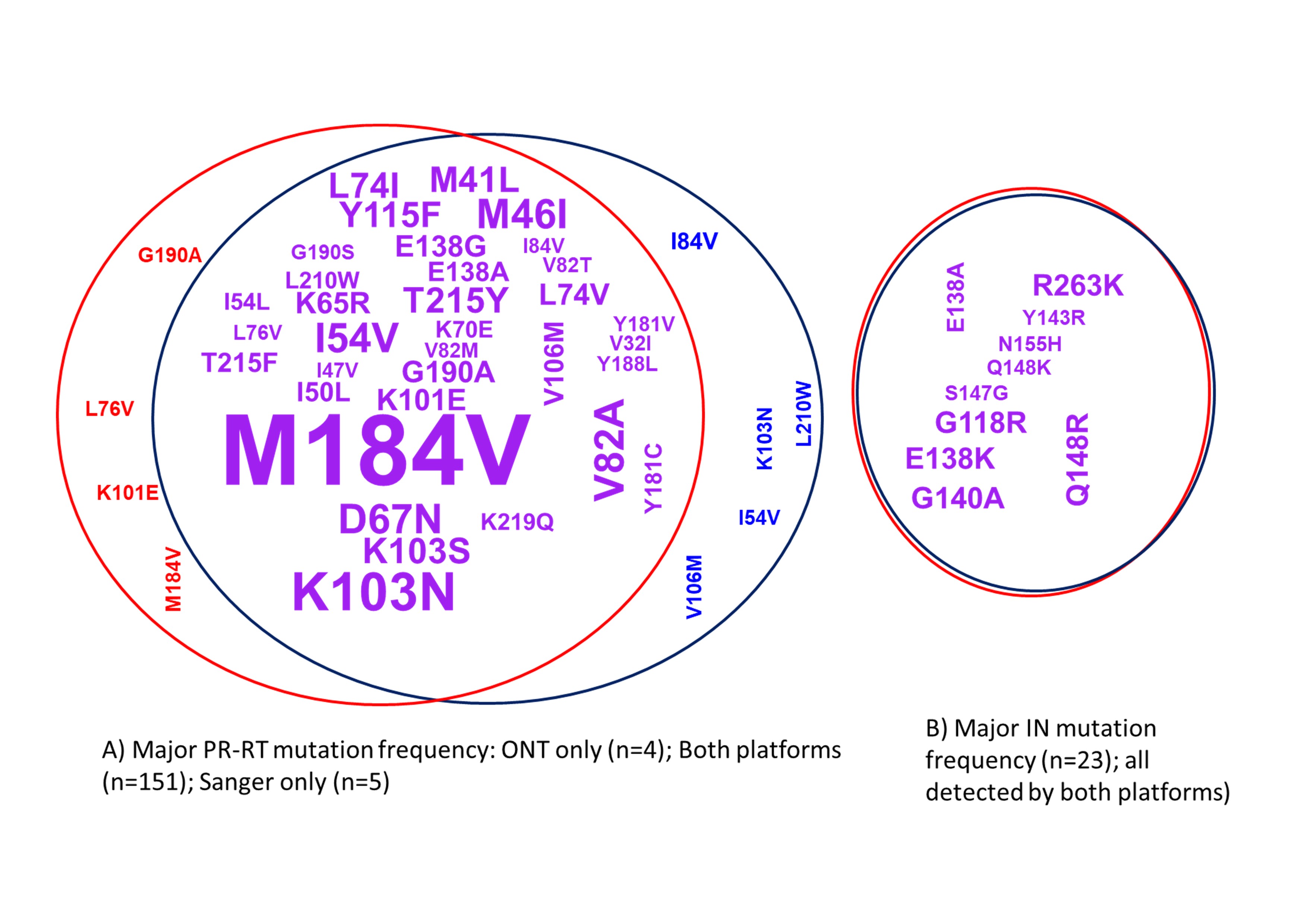
PCR amplification success rates at viral load strata 200-1 000, 1 000-10 000 and >10 000 copies/mL were:15/28 (53.6%),15/20(75.0%) and 22/23(95.7%) respectively. Pairwise % identity between ONT and Sanger nucleotide sequences was 99.3% (98.3-100.0) for PR-RT and 99.4%(97.7-99.8) for IN; with a good agreement in major drug resistance mutations detected by both platforms (Figure).
Conclusions:
The novel fast ONT-based full pol-gene provides an alternative to Sanger Sequencing, especially in patients with higher viral loads. Discordant cases with Sanger Sequencing are likely a combination of PCR resampling error and small differences in the sequencing platforms. Our assay combined with NanoRecall interpretation provides an assay suitable for the use cases of drug resistance surveillance and individual patient management in resource limited settings.