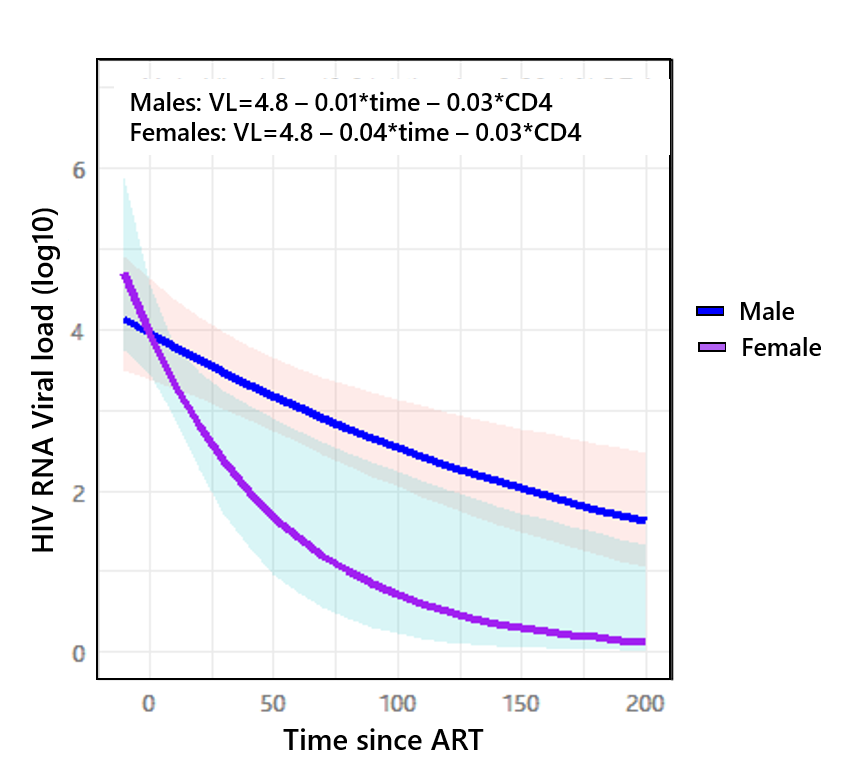
Women living with HIV have lower HIV RNA levels and higher CD4 cell counts than men. However, limited data exist regarding sex bias and viral decay in children with HIV. We investigated the sex differences in viral decay and control of viremia in HIV perinatally infected children who suppressed viral load within 12-months of treatment initiation and describe the association between viral decay and DNA reservoir size.
We analysed data from 25 patients from four European cohorts of perinatally infected children (CARMA Study). We estimated the breakpoints on viral decay trends to distinguish viremia control phases and slopes using a piecewise regression model. The effect of sex on the viral decay was analysed using a multivariable mixed model regression and cell lifespan was extrapolated using the ushr tool. The association between viral decay in phase-I and DNA reservoir size was estimated using a multivariable Poisson regression model.
Females (n=17, 68%) and males presented similar HIV RNA levels (5.7 [5.25;6.0] vs. 5.7 [5.13;5.81, p=0.883]) and % CD4 (29.0 cells/mm3 [18.0;36.25] vs. 31.5 [20.75;41.75]) at ART initiation. No differences were found between sexes relating age at ART, age at HIV diagnosis, or time to suppression. However, females reached phase-II significantly earlier than male (3.0 months [1.44;4.85] vs. 6.79 months [5.14;9.94], p=0.023). For each month elapsed, females had faster viral decay than male (interaction coefficient= -0.01±0.001).
Females presented faster phase-I viral decay regardless their age at ART initiation, baseline %CD4, or baseline RNA levels.