Spain is close to HCV microelimination, so rates of recently acquired HCV infection (RAHC) should decrease. Nowadays, men who have sex with men (MSM) carry the highest risk of HCV acquisition. Our aim was to estimate the incidence of and the factors associated with RAHC, together with reinfection rates, among patients infected with HIV through sexual intercourse.
This was a prospective cohort study conducted at four hospitals in Spain. MSM and non-MSM infected with HIV through sexual intercourse patients consecutively attending these hospitals were included. Primary RAHC infection was diagnosed when anti-HCV antibody seroconversion was documented. In anti-HCV positive patients, initially without HCV viremia, a diagnosis of reinfection was established if plasma HCV RNA was detected.
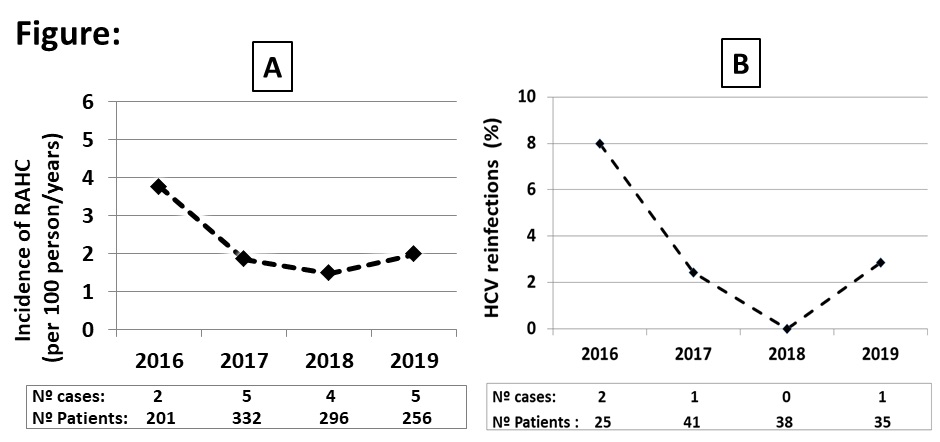
Three hundred and fifty patients tested negative for anti-HCV at baseline and had at least one follow-up visit. Among them, there were 16 RAHC cases from 2016 to 2019. RAHC incidence rates [IR (95% CI)] per 100 person-years (py) were 3.77 (0.5-12.9) in 2016, 1.85 (0.6-4.3) in 2017, 1.49 (0.4-3.8) in 2018 and 1.98 (0.6-4.5) in 2019 (Figure 1A). Only previous sexually transmitted infections (IRR: 18.23; 95% CI 1.93-172.1; p=0.011), male sex (IRR: 8.33; 95% CI 1.38-54.15; p=0.026) and sharing chem-sex drugs (IRR: 4.93; 95% CI 1.17-20.76; p=0.030), were independently associated with RAHC. Four of 42 (9.5%) patients became reinfected (Figure 1B).
The incidence of RAHC among HIV-infected patients showed a decrease after 2016, although a lower but steady incidence of residual cases still remains. HCV reinfections showed a similar pattern. New infections were associated with sharing chem-sex drugs among MSM. This suggests that the elimination of HCV infection in patients infected with HIV through sexual intercourse slowed down since 2017, likely due to sexual contacts with HCV-infected MSM without HIV-infection who remain undiagnosed.