Background:
Relationships between tenofovir-diphosphate (TFV-DP) steady-state concentrations (Css) in peripheral blood mononuclear cells (PBMCs), dried blood spots (DBS), and adherence have not been well-described in people with HIV (PWH) on tenofovir-alafenamide (TAF)-containing antiretroviral therapy (ART). Our objectives were to assess the influence of adherence and other factors on TFV-DP Css in PBMCs, and to examine relationships between TFV-DP Css in DBS and PBMC.
Methods:
QUANTI-TAF was a 16-week observational study that enrolled PWH on TAF-based ART for >6 months. Study visits occurred at weeks 0, 4, 8, 12, and 16. Blood was collected for TFV-DP in DBS (2x7mm punches) and PBMC (per 106 cells) at each visit and quantified using validated LC-MS/MS methods. Adherence was quantified using TAF-based ART co-encapsulated with an ingestible biosensor (calculated as # ingestions in the 10 days before each visit). Week 4 TFV-DP Css in PBMC were dichotomized by 5-8 vs. 9-10 days of dosing in the 10-day window. A linear mixed-effects model with backward selection was used to evaluate factors associated with TFV-DP Css in PBMC (all visits), and included adherence, age, sex, weight, BMI, race, eGFR, CD4, and NNRTI or INSTI. Pearson correlation compared week 4 TFV-DP Css in DBS and PBMC.
Results:
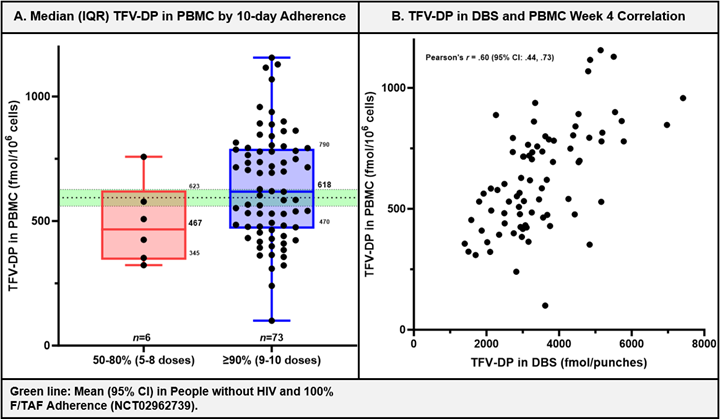
Data were available in 84 PWH (55% White, 24% Black, 21% Hispanic/Latino) on TAF for median (IQR) 32 (18, 45) months (79 unboosted [un/], 5 boosted [b/]). Median (IQR) age was 54 (43, 59) years; most were males (89%) on INSTIs (88%). Median TFV-DP Css in PBMC in PWH on un/ART were 32% higher for 9-10 vs. 5-8 days of dosing (Fig. A). Median TFV-DP Css for b/ART was 72% higher than un/ART (1007 [IQR: 868, 1297] vs. 585 [IQR: 459, 780] fmol/106 cells, respectively). Ten-day adherence was the only significant predictor, with every 10% adherence increase associated with an average TFV-DP in PBMC increase of 32 (95% CI: 14, 49; P=0.0005) fmol/106 cells. Week 4 TFV-DP Css in DBS and PBMC were moderately correlated (Fig. B).
Conclusions:
10-day digital pill adherence was a significant predictor of TFV-DP in PBMC. TFV-DP was higher in PWH on b/ART, which may enhance virologic effect, dose forgiveness, and/or side effects. TFV-DP in DBS and PBMC were moderately correlated, which may be due in part to TFV-DP in PBMC being more susceptible to recent non-adherence given the shorter half-life in PBMC vs. DBS (2 vs. 17 days). Further investigation of other factors contributing to variability in TFV-DP in PBMCs is warranted.