Background:
Many factors influence pubertal onset including in utero exposure to medications and infections. Few studies have evaluated the influence of in utero HIV/antiretroviral exposure on pubertal onset in children who are HIV-exposed and uninfected (CHEU).
Methods:
CHEU in the Surveillance Monitoring for ART Toxicities study of the Pediatric HIV/AIDS Cohort Study and children who are HIV-unexposed/uninfected (CHUU) in the Bone Mineral Density Cohort with sexual maturity rating (SMR) assessments at age 9yr (±4mo) were included. Puberty was defined as SMR >2 separately by sex assigned at birth (girls: breasts and/or pubic hair; boys: genitalia and/or pubic hair). Weights were used to standardize sex and racial distribution of CHUU to CHEU. Log-binomial regression models were fit to estimate the adjusted relative risks (RR) for puberty at age 9 in CHEU vs. CHUU. Among CHEU, log-binomial regression models were fit to assess the association of puberty at age 9 with: 1) protease inhibitor (PI) exposure at ≤30wk gestation, 2) maternal CD4 ≤200 vs. >200cells/mm3, 3) HIV viral load (VL) copies/mL, and 4) child body mass index (BMI) >95th percentile.
Results:
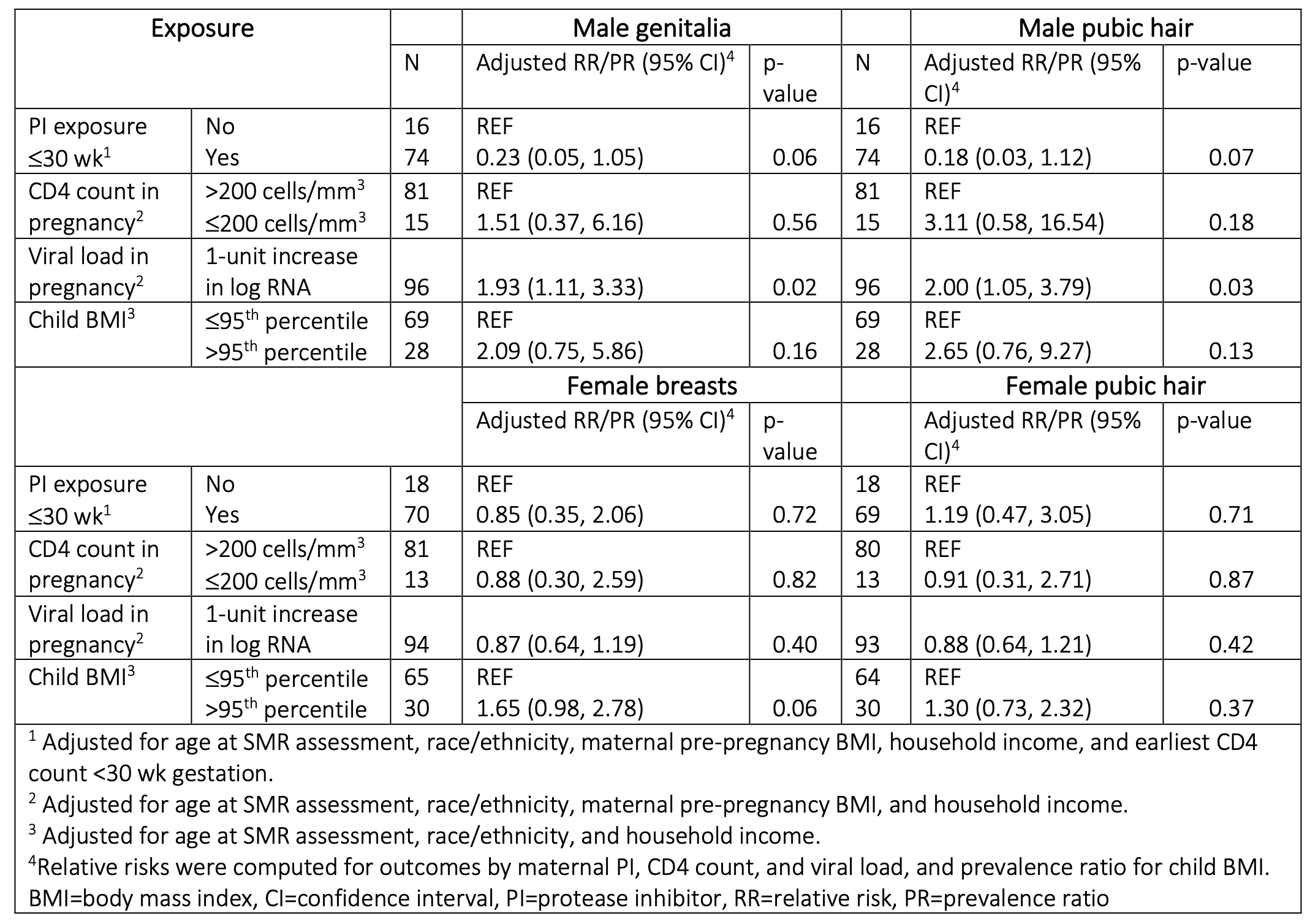
227 CHEU (113 boys, 114 girls) and 344 CHUU (162 boys, 182 girls) were included. CHEU boys were more likely to have reached puberty by age 9 compared to CHUU boys (15% vs 9.9% genitalia, 11.2% vs 3.7% pubic hair, 10.3% vs 2.5% both), with an estimated 2-fold higher (RR=2.07, 95%CI 0.89, 4.79) risk for genitalia and 3.5 fold higher risk (RR=3.55, 95%CI 0.92, 13.81) for pubic hair. Among girls, the presence of puberty at age 9 in CHEU and CHUU was 35.2% vs 23.1% for breasts, 32.4% vs 14.8% for pubic hair, 27.8% vs 8.8% for both) with similar risks for breast (RR=0.96, 95%CI 0.65, 1.41) and pubic hair (RR=1.10, 95%CI 0.70, 1.72). Among CHEU, 74% were exposed to PIs at ≤30wk gestation. Factors associated with CHEU having begun puberty by age 9 differed by sex (Table). Among boys, those with PI exposure at ≤30wk gestation had a lower risk of reaching puberty by age 9 for genitalia and pubic hair, while higher maternal VL in pregnancy increased the risk of both outcomes. For girls, high BMI was associated with a higher prevalence of SMR >2 breasts.
Conclusions:
Male CHEU were more likely to have reached puberty by age 9 compared to CHUU. Higher maternal viremia in pregnancy was associated with higher risk and PI exposure with lower risk of presence of puberty at age 9 in males, but not in females. Further confirmatory and mechanistic studies are warranted.
Table: Adjusted associations of PI exposure, CD4 count, viral load in pregnancy, and child BMI with sexual maturity rating (SMR) greater than or equal to 2 for each indicator by sex for CHEU.