Background:
The US Ending the HIV Epidemic (EHE) initiative has set goals to reduce national HIV incidence by 90% by 2030 and to address the disproportionate burden of HIV among Black and Hispanic/Latinx populations. The statewide HIV planning body for Florida recently released its 2022-2026 “Integrated HIV Prevention and Care Plan”, which lists strategies to increase access and uptake of HIV prevention and treatment interventions to reach the national EHE goals. Using a case study, we estimate and compare the epidemiological impact of achieving targets individually and jointly and sustaining them from 2022-2030.
Methods:
We adapted an HIV transmission model calibrated to Miami-Dade County and adjusted the scale of HIV testing, PrEP, and ART interventions to simulate the effects of reaching targets that could be modeled from Florida’s 2022-2026 integrated plan. We defined a comparator scenario based on estimates of current population characteristics and health service access levels in Miami and set 2020 as a reference point to match the EHE timeline. Multiplicative factors were applied to reach the rate changes specified by the plan’s current and target data indicator values. Resulting increases to service access were assumed (a) proportional to existing access levels across White, Black, and Hispanic/Latinx populations, and (b) equitably redistributed across racial/ethnic groups according to their numbers of new diagnoses in 2019. The primary outcome for each approach was HIV incidence reduction from 2022-2030.
Results:
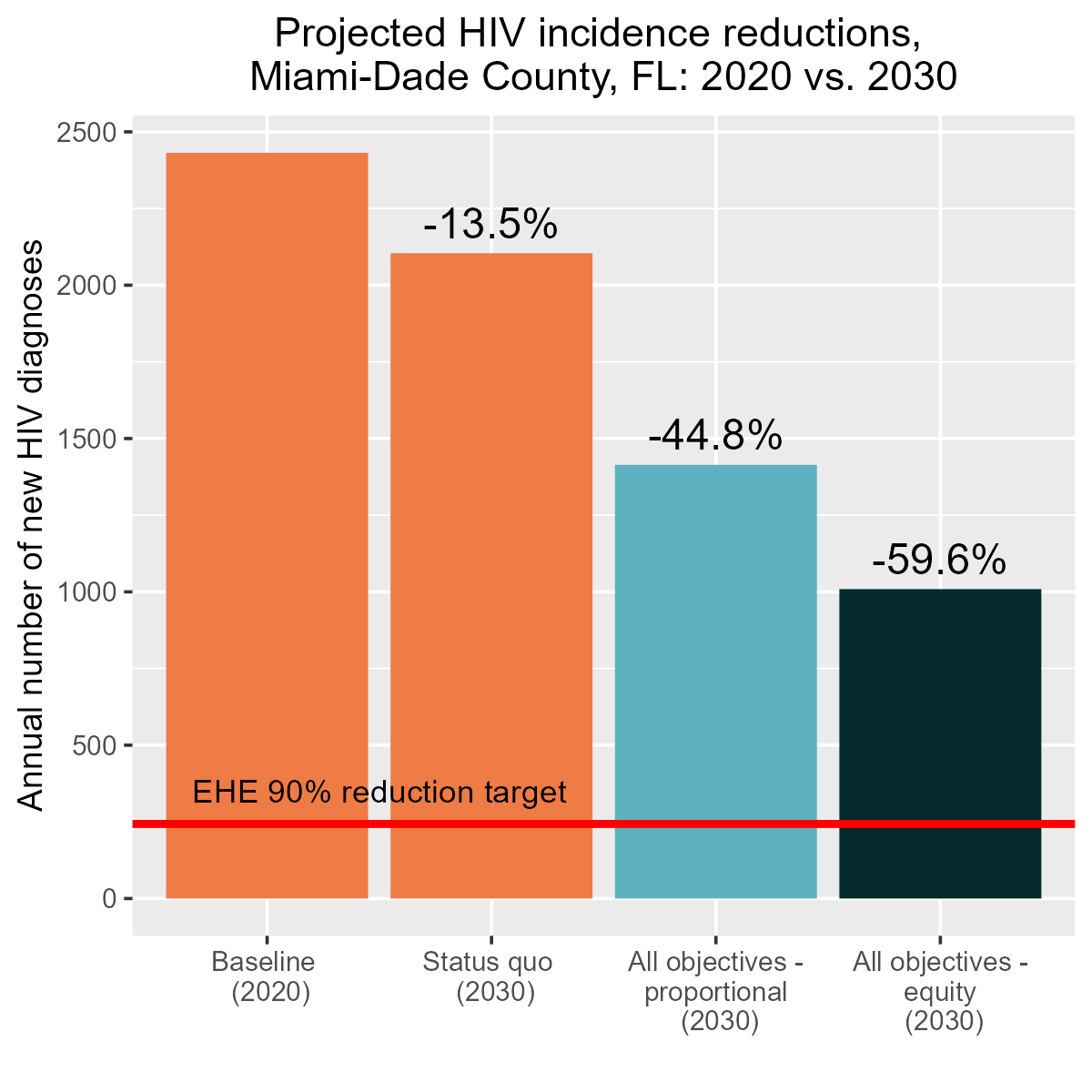
Compared to 2,432 infections in 2020, incidence reductions in 2030 from sustaining each of the targets in Miami would range from 1,018 (-41.8%) cases under the proportional approach to 1,423 (-58.5%) with the equitably redistributed approach (Figure 1). The single most influential strategy was reducing new HIV diagnoses in Hispanic/Latinx men who have sex with men via increased PrEP uptake, which dropped 2030 incidence to 1,537 (-37%) cases. Achieving the current integrated care plan goals would not achieve the EHE incidence reduction target ( < 243 new cases in 2030).
Conclusions:
Achieving the goals of Florida’s current integrated care plan would reduce HIV incidence dramatically in Miami, however further efforts are required to achieve EHE targets by 2030. Structural changes in service delivery and a focus on effective implementation of available interventions, particularly among Black and Hispanic/Latinx populations, will be crucial to overcoming the HIV epidemic in Miami, Florida.
Figure 1. Projected HIV incidence reductions, Miami-Dade County, FL: 2020 vs. 2030