Background:
The mpox outbreak of 2022 disproportionally and rapidly affected men, the LGBTQ+ community, and people living with HIV (PLWH). NYC was declared the nation’s epicenter, with 3,816 cases reported as of December 26, 2022. NYC rolled out a JynneosTM vaccination program, initially subcutaneously (SC) as a full dose then intradermally (ID) as a low dose; of note, ID route previously has not been evaluated in PLWH. This study was developed to assess the immunity, tolerability, and safety of SQ and ID mpox vaccinations in those with and without HIV.
Methods:
A longitudinal, observational study of adults (PLWH and HIV-) who have received the JYNNEOS vaccine or with history of mpox infection in NYC was rapidly established. Immunogenicity endpoint is measured as the GMT of serum neutralization of mpox live virus; mpox-specific binding IgG titers are a secondary endpoint. Tolerability is assessed through a reactogenicity diary. Safety is monitored by capturing adverse events (AE) and serious AE (SAE). Vaccine acceptability is measured via a knowledge, attitudes, and practices (KAP) survey. Up to 300 participants will be enrolled.
Results:
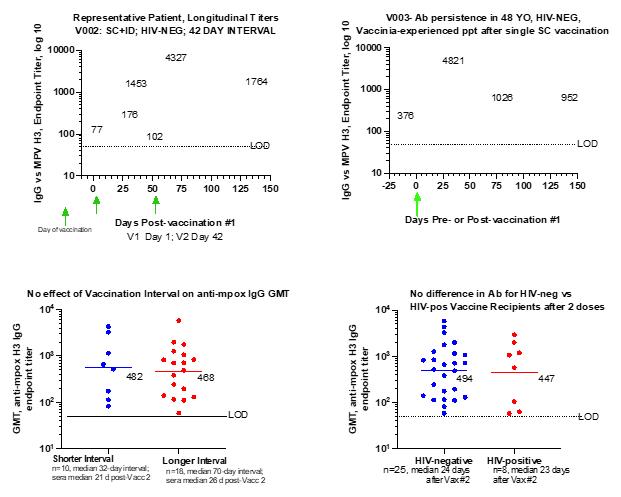
As of January 3, 2023, 54 participants have been enrolled, median age is 39 years, 31% are PLWH (median CD4 count 790), most identify as male (87%) and as LGBTQ+ (92%), with diverse ethnic backgrounds (61% White, 17% Asian, and 22% Black/African American, Native, or other races; and 28% Hispanic or Latino ethnicity). SC followed by ID has been the most common route of administration (45%). Preliminary immunogenicity data (see Figure) shows no significant differences in mpox-specific binding IgG antibody titers between shorter vs longer interval or between PLWH and HIV- participants regardless of the route of administration (by non-parametric Kruskal–Wallis multiple comparisons). Reactogenicity is higher with ID vs SC, with redness (53% ID vs 15% SC) the most common reaction. No SAE have been reported.
Conclusions:
Rapid implementation of vaccine studies that respond in real-time to epidemics and include disproportionally-affected populations are an integral part of the public health response. The data resulting from this study will fill knowledge gaps, inform public health practices, guide policymakers, and address community concerns regarding the absence of data for low-dose ID vaccinations in PLWH. Preliminary antibody data suggest PLWH with preserved CD4+ T cell counts respond well to the vaccine.
Preliminary Immunogenicity Data