Untreated HIV infection causes accentuated epigenetic aging which is partially reversed by antiretroviral therapy (ART) initiation (Lancet HIV, in press). It remains unclear whether epigenetic aging continues to accelerate over time in people living with HIV (PLWH) receiving suppressive ART.
We analyzed 63 participants from a prospective cohort of long-term treated aviremic HIV-infected adults at two timepoints (baseline and 4 years of follow-up). Whole blood DNA methylation profiles were obtained by Illumina Infinium MethylationEPIC BeadChip. We evaluated 4 epigenetic clocks (Horvath and Hannum´s clocks, PhenoAge and GrimAge), and calculated epigenetic age acceleration (EAA) for each one as the residuals resulting from the regression of epigenetic age on chronological age using a mixed-effects linear regression model.
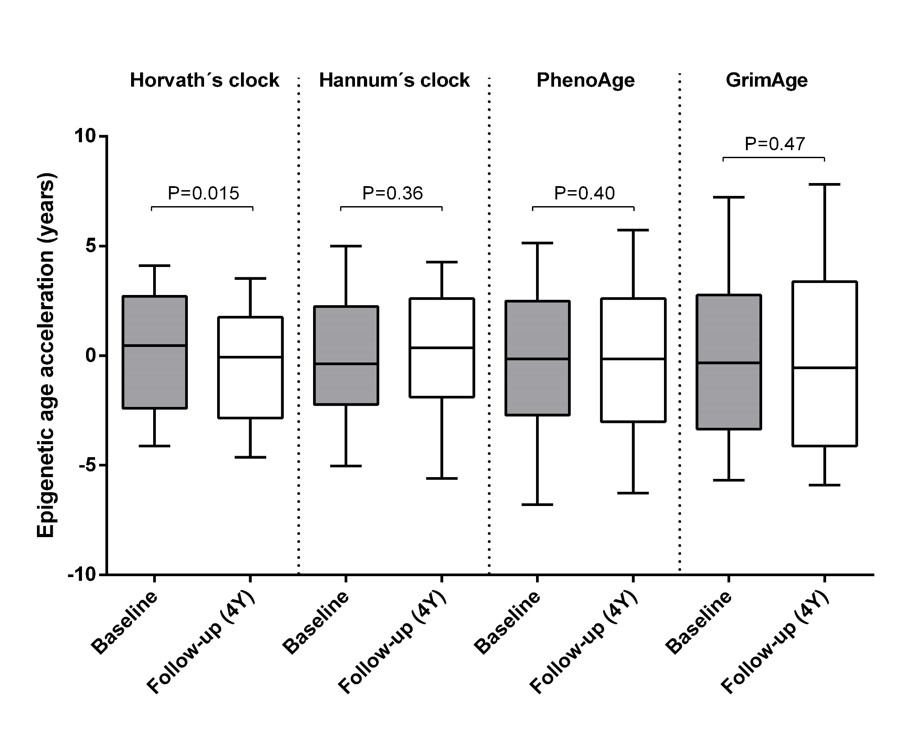
At baseline, participants were predominantly male (82.5%) and Caucasian (93.7%), median chronological age was 48.7 years (IQR 44.2-53.5), median time since HIV infection diagnosis was 18 years (IQR 13.7-22.3) and median CD4 cell counts was 770 cells/µl (IQR 575-922). 32 participants (50.8%) were receiving a tenofovir (TFV) containing regimen and 31 (49.2%) were never exposed to TFV (of whom 15 were receiving abacavir and 16 a nucleos[t]ide reverse transcriptase inhibitor sparing regimen). All participants were virologically suppressed at the two timepoints. After 4 years of follow up, Horvath-EAA slightly decreased (mean difference: -0.66 years, p=0.015), whereas Hannum-EAA, PhenoAge-EAA and GrimAge-EAA did not vary over time (mean differences: 0.05 years, p=0.36; 0.39 years, p=0.40 and -0.21 years, p=0.47; respectively) (Figure). We found no differences in any EAA measure over time between participants receiving a TFV based-regimen or those never exposed to TFV. Changes in CD4 counts after follow-up were not associated with changes in any of the analyzed EAA measures.
Epigenetic aging did not accelerate in a cohort of aviremic HIV-infected adults after four years of follow-up, independently of the antiretroviral regimen and CD4 changes. These results are not consistent with an accelerated biological aging process during successfully treated HIV infection.