Background:
DNA methylation (DNAm) patterns indicate a trend towards epigenetic age advancement in older persons with HIV (OPWH), however, data on relationships with phenotypic changes are limited. We investigated associations between phenotypic measures of cognition, frailty, and 7-year survival with epigenetic age estimates derived from the modification of DNAm in a population of OPWH.
Methods:
OPWH aged 50 and older in clinical care for HIV management at Weill Cornell in NYC, were recruited to participate in a detailed biopsychosocial survey, and those age 55 and older were invited to complete an in-person study visit which included blood draw, Montreal Cognitive Assessment (MoCA) and Fried frailty phenotype testing. Genome-wide DNAm was measured from dried blood spots using the Illumina MethylationEPIC platform and analyzed using PhenoAge epigenetic age.
Results:
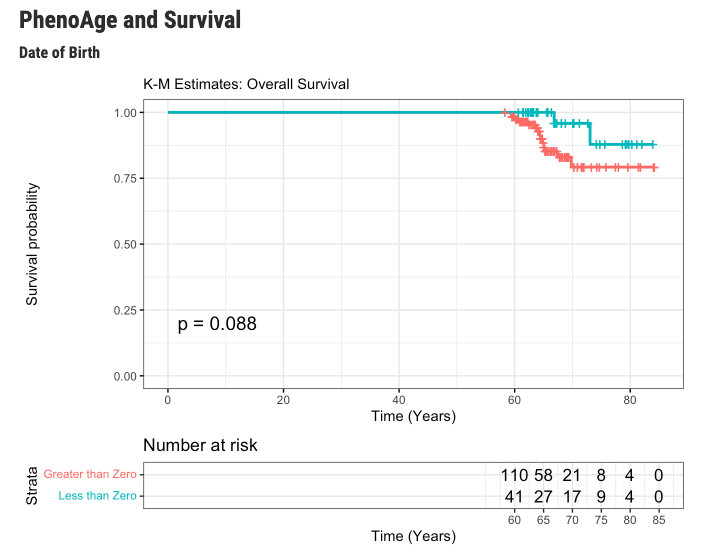
A total of 164 participants enrolled in the study; 158 had available biospecimens for DNAm analysis. Median age was 60 years (IQR 56-64), 52 (33%) identified as female, and 76 (50%) identified as Black, median CD4 T-cell count was 588 cells/mmˆ3 (IQR: 323-811) and 93% were virally suppressed on ART. Epigenetic age analysis indicated an average epigenetic ‘age advancement’ (EAA) of 5.4 years (SD 6.6). Median MoCA score was 24 (21-27) and 67% were pre-frail or frail. There were 17 deaths (10.7% mortality rate) from September 2016-September 2023. EAA was inversely related to chronologic age (ß= -0.31 [95%CI: -0.48, -0.14] (p<0.01)) and was associated with lower CD4 T-cell count (ß= -0.84 [95% CI: -1.14, -0.53] for every 100 CD4+ T-cells (p<0.01)) in an unadjusted linear regression model. EAA was associated with lower MoCA score in a linear regression model adjusted for age, sex and race (p<0.01), and there was a trend towards EAA association with more advanced frailty state in an ordinal logistic regression model adjusted for age, sex and race (p=0.07). Survival differed by EAA, and greater advancement was associated with 7-year mortality in a Cox Proportional Hazard model adjusted for age (HR 1.10 [95%CI: 1.02, 1.18] p=0.01) (Figure 1).
Conclusions:
In OPWH the average EAA was 5.4 years, as calculated by PhenoAge, and was associated with cognitive dysfunction, more advanced frailty state, as well as 7-year mortality. These results suggest epigenetic clocks are a valuable biomarker of aging-related pathologies in OPWH and warrant further study.