Background:
Among people with HIV (PWH), COVID-19 is common and potentially severe. We leveraged data from the Randomized Trial to Prevent Vascular Events in HIV (REPRIEVE) to assess effects of pitavastatin on COVID-19 outcomes (incidence and serious cases) among a global cohort of PWH. Statin therapy was a priori hypothesized to reduce serious COVID-19 by 35%, with 200 anticipated serious COVID-19 events.
Methods:
COVID-19 data collection was implemented in REPRIEVE in April 2020 to capture all events from the start of 2020. COVID-19 was defined by positive test or clinical diagnosis; serious COVID-19 according to ICH definition, including life-threatening events or those resulting in hospitalization or death. Among participants in follow-up on January 1, 2020, Cox proportional hazards modeling was used to estimate the hazard ratio (HR) of COVID-19 (pitavastatin/placebo), stratified by global burden of disease region. Modification of statin effect following COVID-19 vaccination was evaluated via interaction with time-updated vaccination status.
Results:
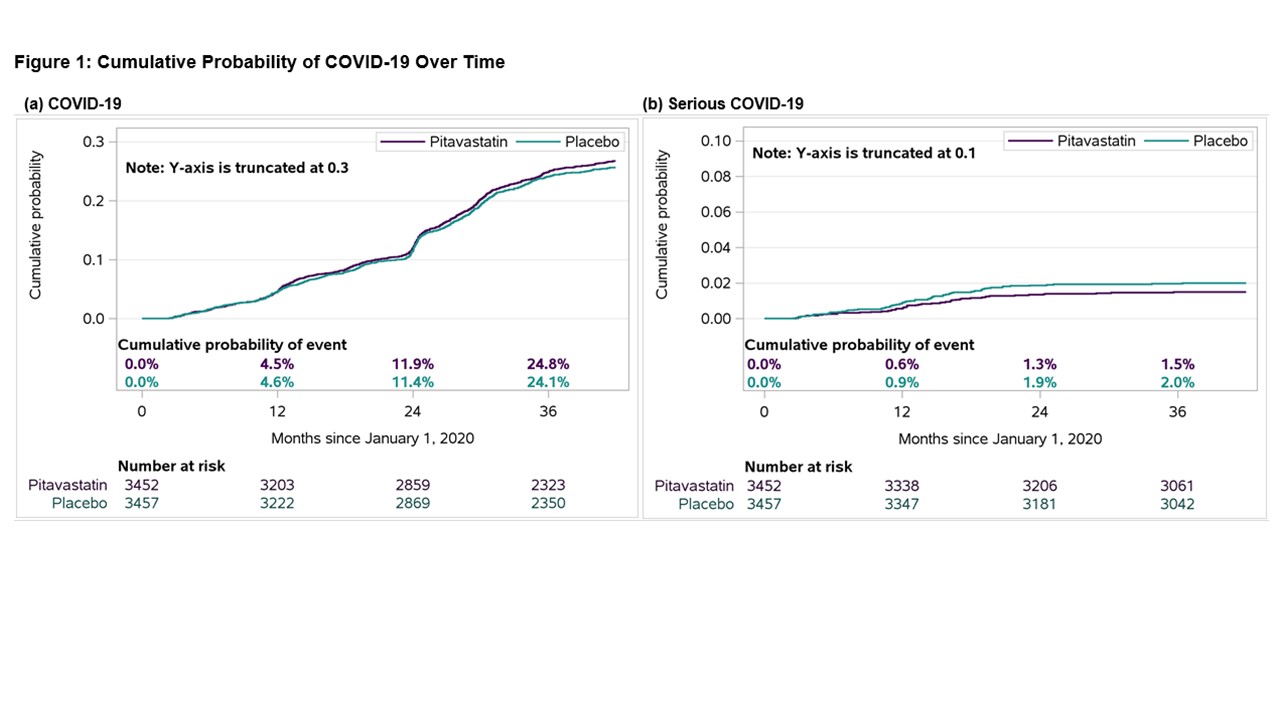
Among 6909 PWH, 32% were natal females and 41% were Black or African-American. Median age was 53 years and median 10-year ASCVD risk score 4.5%. HIV-1 viremia was suppressed in 87%, 30% had CD4 <500 cells/mm3, 23% BMI ≥30 kg/m2, 45% hypertension, and 3% diabetes. Treatment groups were balanced on baseline characteristics. COVID-19 was reported in 1689 participants, including 117 serious cases (Figure 1). Statin therapy did not reduce COVID-19 incidence (HR 1.05, 95% CI: 0.95-1.15) but appeared to reduce incidence of serious COVID-19 (0.75, 0.52-1.09). Among the 1689 with COVID-19, the relative risk (pitavastatin/placebo) for serious COVID-19 was 0.73 (0.52-1.03). Treatment effect size for serious COVID-19 fell within the hypothesized range, but CI crossed 1 given fewer-than-anticipated cases (117 vs. 200). 83% reported COVID-19 vaccination by end-of-study, with a strong protective effect on serious COVID-19 (HR 0.28, p<0.0001). Protective statin effect was observed prior to vaccination (0.74, 0.50-1.10; 42/58 cases), with only 17 cases observed following vaccination (0.87, 0.33-2.24; 8/9).
Conclusions:
In a global cohort of PWH, statin therapy had no effect on COVID-19 incidence but showed potential to reduce the risk of serious COVID-19 prior to COVID-19 vaccination. Vaccination was protective for serious COVID-19. Additional research is needed to understand and harness potential mechanisms of protective statin effects on serious COVID-19.