Background:
Diagnosis of M. tuberculosis (Mtb) infection in close tuberculosis (TB) contacts is critical for TB control. Interferon-gamma release assays (IGRAs) diagnose Mtb infection, but the test is limited by assay variability, including the conversion (negative to positive) and reversion (positive to negative) of IGRA responses that may not always reflect changes in Mtb infection status. Several studies have revealed that smoking is a risk factor for Mtb infection and TB disease but its effect on longitudinal IGRA results remains unknown.
Methods:
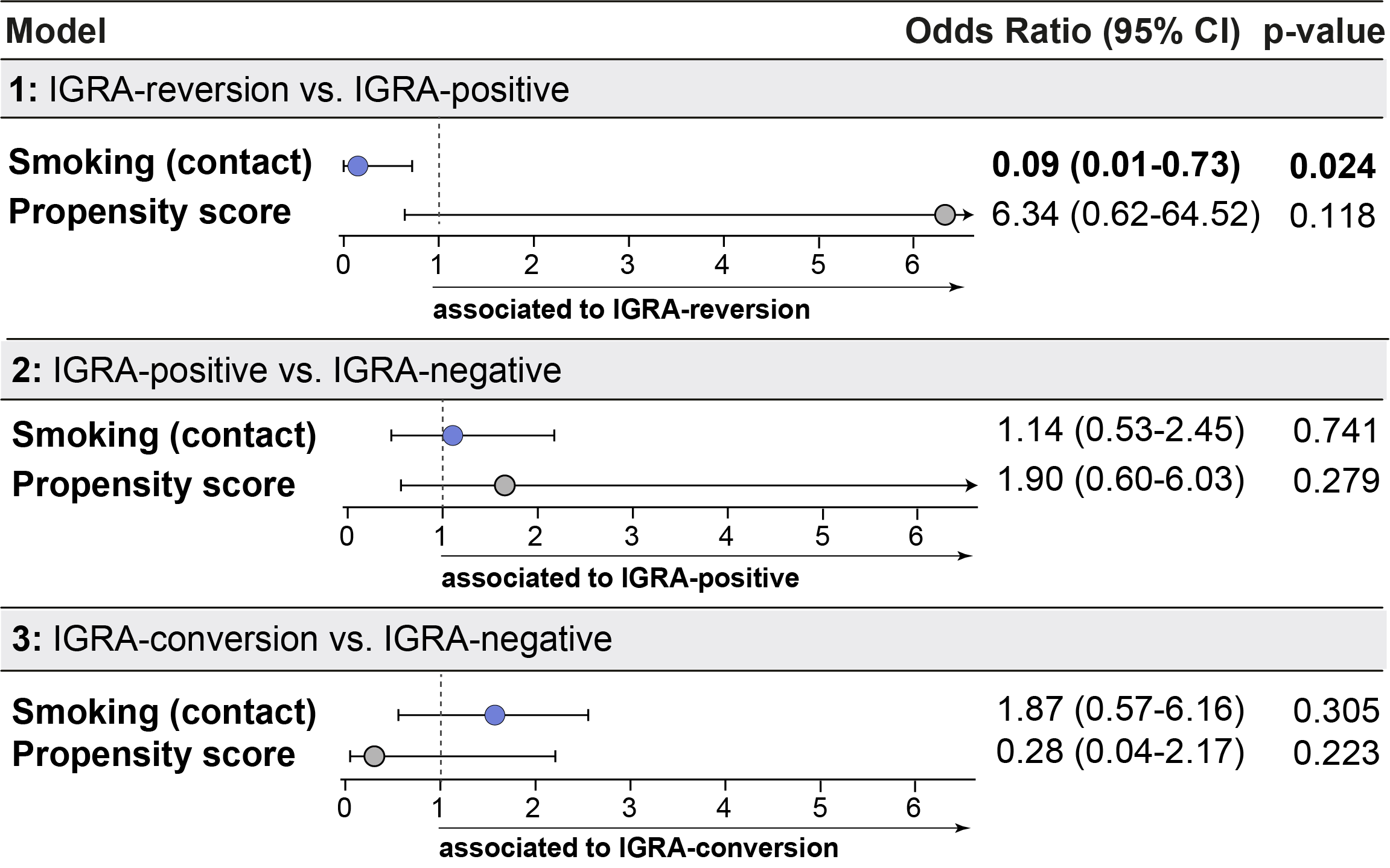
We conducted a multi-site prospective study in RePORT-Brazil between 2015-2019 among close contacts of adults with culture-confirmed pulmonary TB. IGRA testing was performed at baseline, month 6 and month 24-30 after enrollment. IGRA results were categorized as IGRA-positive (maintained from baseline to last visit), IGRA-conversion (from negative to positive at any time), IGRA-reversion (from positive to negative at any time), and IGRA-negative (maintained from baseline to last visit). Associations between IGRA results and smoking status at baseline (current/former vs never) in contacts were evaluated using propensity score-adjusted logistic regression models to avoid overfitting. More specifically, we first estimated the propensity of smoking using Lasso. Next, this estimated propensity score was used as a covariate in the main outcome model, which regressed the outcome (IGRA-positive, IGRA-conversion, IGRA-reversion) on smoking status.
Results:
There were 430 close contacts of 139 TB cases. Of the contacts, 89 (21%) were IGRA-positive, 30 (7%) were converters, and 30 (7%) were reverters; 22 (5.1%) had an indeterminate result. The frequency of smoking among contacts was 26 (29.2%), 7 (23.3%) and 3 (10%) in IGRA-positive, IGRA-conversion and IGRA-reversion groups, correspondingly. Smoking in contacts was associated with lower odds for IGRA-reversion (adjusted odds ratio=0.09; 95% confidence interval=[0.01;0.73]). We did not detect associations between smoking and IGRA-positive or IGRA-conversion at the 5% level.
Conclusions:
Contacts who reported smoking (past/former) had lower odds of reverting from an IGRA-positive to an IGRA-negative result. Our findings highlight the importance of smoking on longitudinal IGRA results. This has implications for clinical care and clinical trials in which IGRA status is monitored or used as an outcome, such as TB vaccine trials.