Background:
Evidence is needed to inform antiretroviral therapy (ART) delivery models which allow people with HIV to attend health facilities less frequently. While COVID-19 lockdown measures were in place, South Africa temporarily changed the validity of ‘repeat’ prescriptions for ART from 6 to 12 months. We evaluated the effect of these changes on HIV viral non-suppression in the private health sector in South Africa.
Methods:
We analysed routine laboratory and pharmacy claim data between November 1, 2019, and November 30, 2022 from Aid for AIDS (AfA), a large South African medical insurance scheme. Adults living with HIV over the age of 15 years who had received ART for ≥3 months were included. We conducted an interrupted time-series analysis comparing rates of viral non-suppression (viral load (VL) ≥50 copies/mL) during the following periods: November 1, 2019 to April 23, 2020 when conventional 6-monthly script renewal was in place; April 24, 2020 to September 25, 2021 when the 12-monthly script renewal period was implemented; and September 26, 2021 to November 30, 2022, when 6-monthly script renewal was re-instated. Monthly suppression rates were modelled using binomial generalized linear regression models. We measured the slope change in suppression rates between adjacent time periods by including an interaction term between time and a binary indicator for the 12-monthly script renewal period in the model. Inverse probability weighting was used to account for changes in viral load testing during the period.
Results:
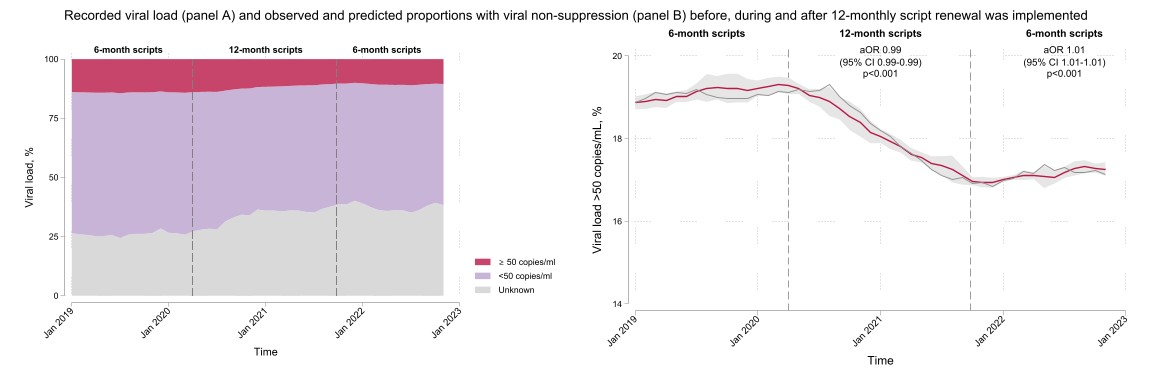
The study population included 73884 in January 2019, increasing to 76321 in May 2020 and 72026 in November 2022. The proportion with unknown VL increased during the study. (Figure A) Compared to the period prior to lockdown, the odds of viral non-suppression was lower among patients when 12-monthly script renewal was in place [adjusted odds ratio (aRR) 0.99, 95% confidence interval (CI) 0.99-0.99, p<0.001]. When 6-monthly script renewal was re-introduced the odds of viral non-suppression increased [aOR 1.02 (95%CI 1.02-1.02, p<0.001). (Figure B)
Conclusions:
Our results show longer script renewal period was associated with slight improvements in viral suppression. Measures implemented during COVID-19 to ensure continued access to chronic medication in South Africa provided a unique opportunity for evidence to guide efficient ART delivery models involving less frequent visits to healthcare providers without negatively affecting treatment outcomes.