Background:
Dose-dependent tolerability reduces the utility of ethionamide for tuberculosis (TB) treatment at standard doses (750 to 1000 mg). Alpibectir (formerly BVL-GSK098) stimulates an alternative pathway of bacterial ethionamide bioactivation leading to retained activity at lower exposures in vivo. We report results on the first cohort evaluating the early bactericidal activity (EBA), safety and tolerability of the alpibectir-ethionamide (AlpE) combination (NCT05473195).
Methods:
Adults with newly diagnosed, rifampicin- and isoniazid-susceptible pulmonary TB were randomised 5:1 to receive 7 days of AlpE 9 mg/250 mg or isoniazid 300 mg as microbiological control. EBA was assessed by the change in time to culture positivity (TTP-EBA[sub]0–7[/sub]) using a mixed-effects model. Serum concentrations of ethionamide and its active sulfoxide metabolite were explored as covaries in a pharmacokinetic/pharmacodynamic (PK/PD) model. Treatment-emergent adverse events (TEAEs) were assessed daily.
Results:
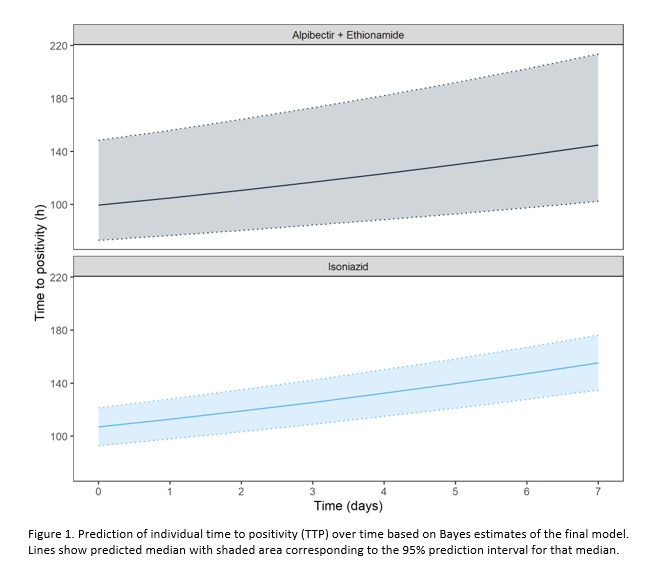
15 participants were randomised to AlpE and 3 to isoniazid. Most participants were male (78%) with a mean age and weight of 33.6 years and 52.9 kg, respectively. One participant withdrew for reasons unrelated to treatment. Median TTP-EBA0–7 (2.5th–97.5th percentiles) was 45.28 (28.78 – 78.12) and 48.41 (42.02 – 54.89) hours for AlpE and isoniazid, respectively. Isoniazid activity was in range of previous results. The median maximum serum concentrations (Cmax) of ethionamide (1230 ng/mL) and ethionamide-sulfoxide (2050 ng/mL), were reached approximately 1 hour after AlpE administration. The mean half-life for ethionamide and ethionamide-sulfoxide was 1.47 hours. Median area under concentration-time curve (AUC) of ethionamide and ethionamide-sulfoxide was 3662 and 5119 h*ng/mL, respectively. Higher ethionamide-sulfoxide exposure significantly increased EBA where each 100 h*ng/mL unit of increase resulted in a 3.68% increase in time to positivity (TTP) slope. 19 (73%) of the 26 mild (76.9%) and moderate (23.1%) TEAEs occurred in AlpE arm, among them self-limiting nausea, flatulence, and diarrhoea in 5 participants.
Conclusions:
AlpE was well tolerated, safe and showed bactericidal activity similar to isoniazid in participants with tuberculosis. AlpE can be added to the growing list of novel antituberculosis agents for drug-susceptible and drug-resistant TB. The study is ongoing with escalating doses of alpibectir and ethionamide to optimize the combination.