Background:
B cell populations significantly decline 2 weeks after initial HIV-1 infection in the absence of ART. However, few studies have characterized longitudinal B cell phenotypic changes after early ART initiation. Here, we compare longitudinal changes in B cell activation and differentiation in PWH in the presence and absence of ART starting from early acute infection in both the periphery and mucosal compartments.
Methods:
Specimens from participants in the RV217 Early Capture HIV Cohort (ECHO) and RV254 Acute HIV Infection (AHI) study were used to assess B cell changes in PWH who are therapy-naïve or treated during early AHI, respectively. Flow cytometry was employed to determine B cell counts and phenotypes in both peripheral blood mononuclear cells (PBMC) and mucosal mononuclear cells (MMC) isolated from sigmoid biopsies at early and chronic infection time points including weeks 0 (AHI diagnosis), 2-4, 12, 24, and 52-96 after infection and in the presence or absence of ART. Healthy donors (RV304) or pre-infection time points (RV217) served as controls.
Results:
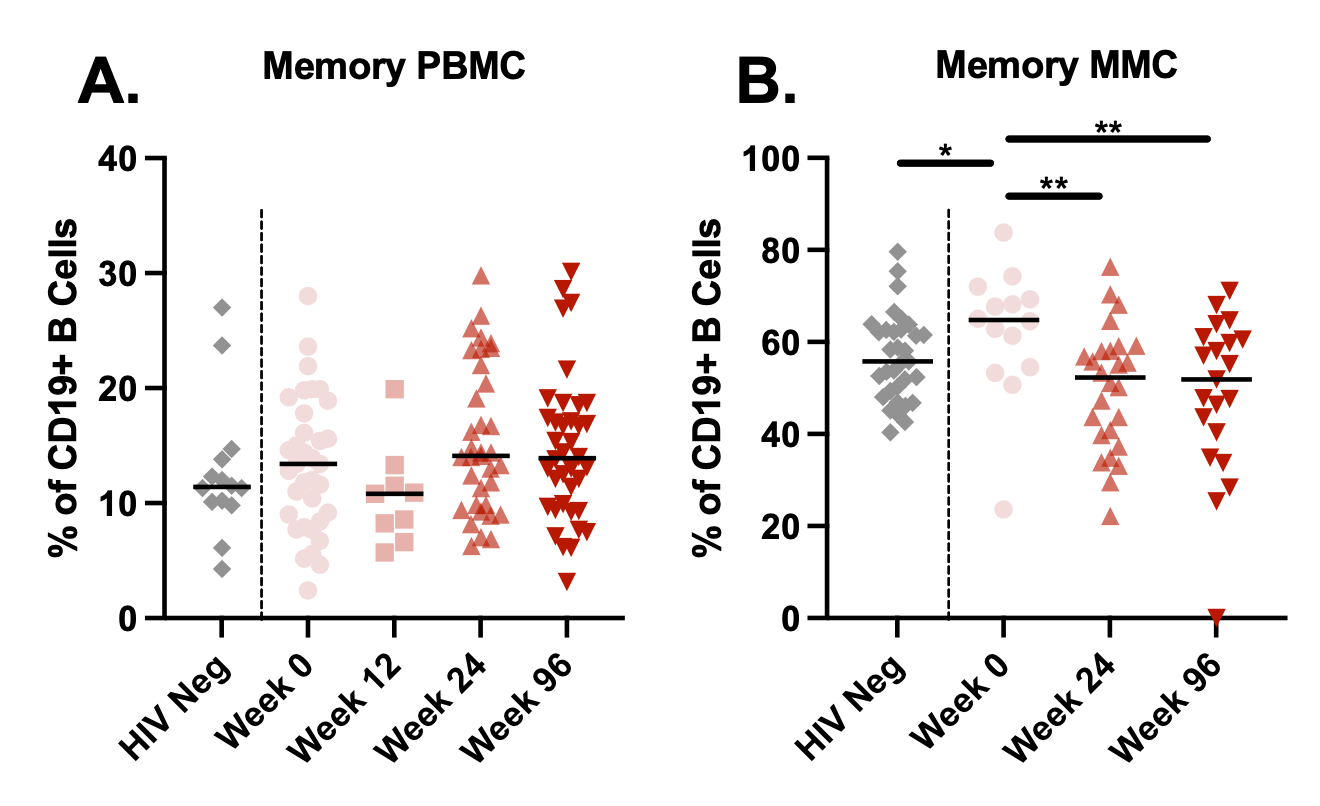
PWH have reduced peripheral B cell counts at diagnosis of AHI; however, administration of early ART resulted in higher peripheral B cell counts and frequencies as early as 2 weeks after ART initiation compared to untreated PWH (p< 0.05). PWH treated during Fiebig stage II or III showed significant increases in peripheral B cell counts between week 0 and week 2 post ART (p< 0.01), whereas PWH treated during Fiebig stage I maintained similar B cell counts at both time points (p >0.05). In the absence of ART, the frequency of peripheral memory B cells decreased and plasmablast populations increased 2 weeks after infection (p< 0.01) compared to uninfected time points. However early administration of ART prevented these changes (p >0.05). Conversely, compared to healthy donors, frequencies of mucosal memory cells were expanded at HIV diagnosis during AHI (week 0) and then declined after ART administration. However, these memory B cell changes were not detected in the periphery (see Figure).
Conclusions:
Early ART administration maintained similar peripheral B cell phenotypes compared to healthy donors whereas later treatment resulted in increased B cell activation and differentiation, likely due to increased antigen load. However, B cell population changes in the sigmoid mucosa were still detected despite early ART administration, suggesting early B cell responses to HIV in mucosal compartments.
The frequency of memory B cells from the periphery (A) or sigmoid biopsies (B) of uninfected (HIV Neg) or ART treated PWH (Week 0-96) was determined by flow cytometry. P-values were calculated using Mann-Whitney.