Aging and immunosenescence predict poor influenza vaccine responsiveness. We sought to determine whether treated HIV is also associated with poor vaccine responsiveness, and if delayed antiretroviral therapy (ART) initiation or persistent immune activation affect vaccine response in this setting.
People with HIV (PWH) with ART-mediated viral suppression >1 year and HIV- controls, all CMV+ and enriched for HIV risk factors, received the seasonal flu vaccine 2014-2018. Total IgG titer against each year’s vaccine antigens were assessed at baseline, 1, and 4 months (M1 and M4, respectively). PWH were stratified by timing of ART initiation (within 6 months of HIV infection [early ART] vs later), and among later initiators, by nadir CD4 count (>350, 200-350, <200 cells/ml). Plasma KT ratio, IP-10, sCD14, sCD163, IL-6, sTNFR2, and suPAR were assessed at baseline. Antibody titer changes after vaccination were assessed with linear mixed-models, adjusted for demographics, health-related behaviors, and timepoint-by-group and biomarker-by-timepoint interaction terms.
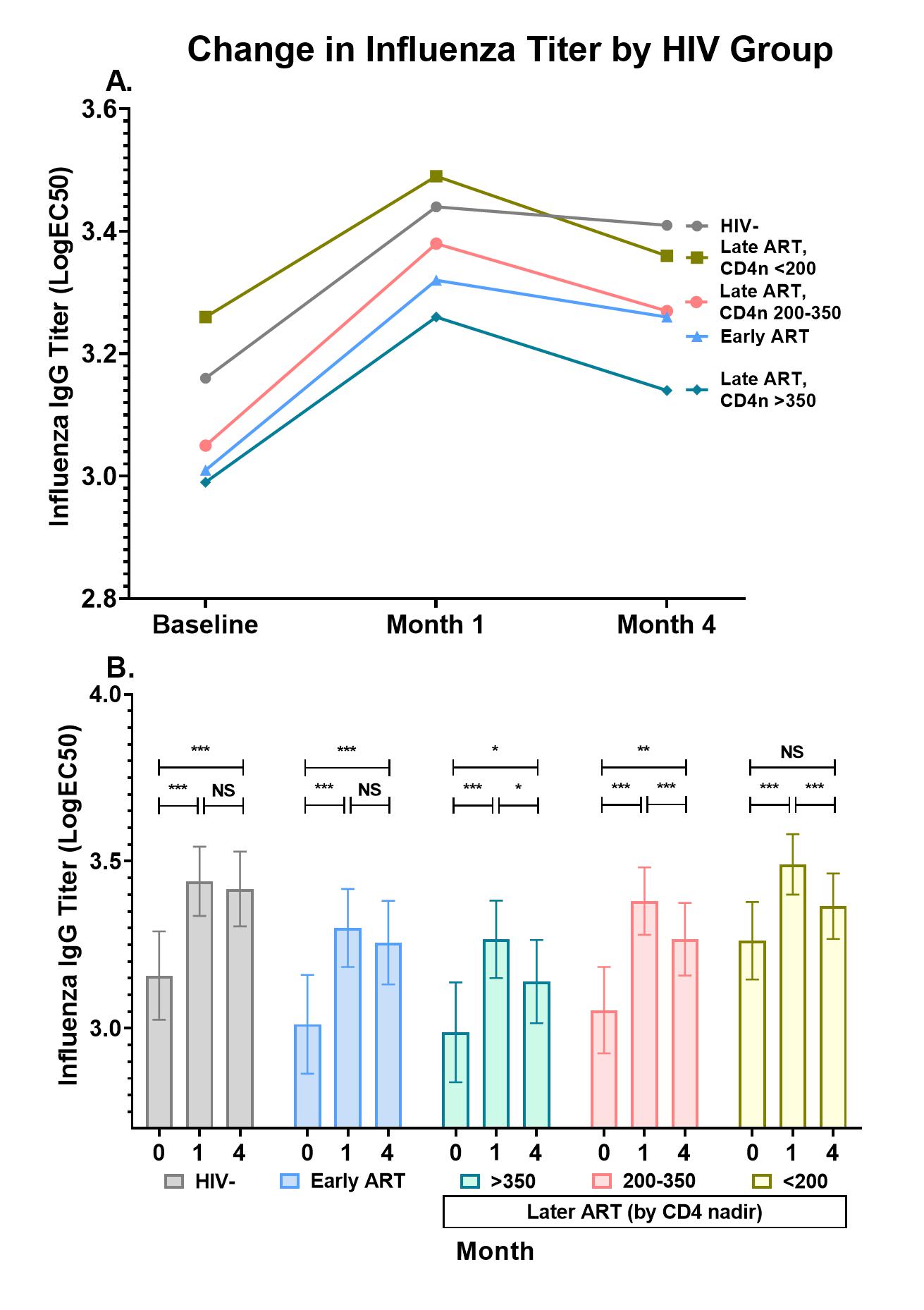
Of 164 PWH and 41 HIV- participants, median age was 54 years and 91% were men. Of the HIV-, 56% were MSM, 34% were current smokers, 15% had distant IDU, and 41% had >100 lifetime male sexual partners. Of the PWH, 34 were early ART initiators, and the remainder had a range of nadir CD4 counts: >350 (n=32), 200-350 (n=43), and <200 cells/ml (n=55). Median duration of viral suppression was 8 years. Flu-specific IgG titers increased from baseline to M1 similarly in all groups. While there was no evidence for titer decay M1 to M4 in HIV- and early ART initiators, later ART initiators experienced significant declines (P<0.04 for all). The extent of titer decay M1 to M4 was impacted by ART initiation timing: compared to HIV-, the early ART group had a similar slope of decay (P=0.66), but the combined later ART groups experienced a significantly greater rate of decline (P=0.02). IP-10 and sCD163, but not other biomarkers, were associated with a 9% greater rate of titer decline M1 to M4 per 1 IQR increase in either biomarker (P=0.05 and P=0.03).
ART-suppressed PWH have similar early humoral responses to influenza vaccination compared to HIV- adults, but only those who start ART within 6 months of infection appear to maintain similar response durability at 4 months. While the clinical implications of these findings remain unclear, some immune activation pathways appear associated with shorter response durability.