Background:
Regional data eliciting associations between antiretroviral treatment (ART) use and adverse maternal and newborn outcomes, including congenital abnormalities (CAs), are limited. We explored the association between periconception dolutegravir (DTG) exposure and the risk of major CAs within the Measuring Adverse Pregnancy and Newborn Congenital Outcomes (MANGO) collaboration in Kenya and South Africa (SA).
Methods:
In MANGO we ascertain delivery outcomes among pregnant women living with HIV (WLHIV) and not living with HIV (WNLHIV) in Eldoret, Kenya and Cape Town, SA. The Kenyan cohort consists of a prospective cohort (i.e., women followed during pregnancy through delivery) and a retrospective cohort (i.e., all women delivering at a tertiary referral facility). The SA cohort is prospective (i.e., all women followed during pregnancy at a primary care facility delivering at two referral facilities). Data from women delivering from 9/25/2020 to 8/17/2022 were stratified by HIV status and ART exposure at conception (i.e., WLHIV on dolutegravir [DTG]- versus non-DTG-containing ART). We used log-link regression models to determine factors associated with risk of major CAs detected at a birth surface exam.
Results:
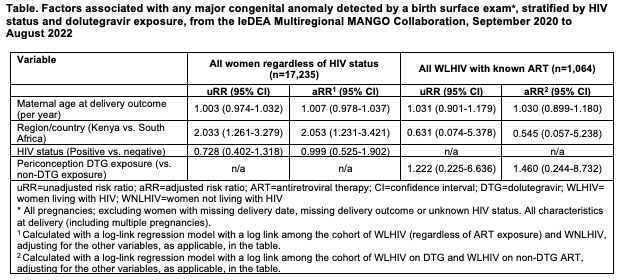
Among 17,235 deliveries, the median maternal age at delivery was 26.0 years, 16,823 (97.6%) were live births, and 2,229 (12.9%) were among WLHIV. Among 1,064 WLHIV with recorded ART exposure, 309 (29.0%) were on DTG-containing ART. Any CAs were detected in 226 births (23.4% polydactyly), and major CAs were detected in 123 births, in 111 (7.40/1000 births) among WNLHIV, 12 (5.38/1000 births) among WLHIV, 2 (6.47/1000 births) among WLHIV on DTG, 4 (5.30/1000 births) among WLHIV on non-DTG ART, and 6 (5.15/100 births) among WLHIV with unknown ART. Major CAs were detected in 1 (1.83/1000 births), 102 (8.64/1000 births), and 20 (4.10/1000 births) among the prospective Kenyan, retrospective Kenyan, and SA cohorts, respectively. Neither HIV status (aRR 1.0, 95% CI 0.53, 1.90) nor DTG exposure (aRR 1.46, 95% CI 0.24, 8.73) were associated with major CAs; the retrospective Kenyan cohort had a higher rate of major CAs detected, likely due to the referral facility receiving women for delivery with known complications.
Conclusions:
We did not find any differences in the risk of major CAs detected by a birth surface exam based on HIV status or periconception DTG exposure. Pharmacovigilance programs need to continue monitoring adverse outcomes as new ARTs become available in HIV endemic settings.
Factors associated with any major congenital anomaly detected by a birth surface exam*, stratified by HIV status and dolutegravir exposure, from the IeDEA Multiregional MANGO Collaboration, September 2020 to August 2022