Background:
Dolutegravir (DTG) use has been associated with increased weight compared to efavirenz in many international settings. As such, we hypothesized that DTG is also associated with greater cardiometabolic risk globally.
Methods:
We performed a cross-sectional study examining associations between DTG use, body mass index (BMI), and metabolic syndrome (MetS; as defined by the International Diabetes Federation) using baseline data of the IeDEA Sentinel Research Network (SRN) cohort study. The SRN prospectively collected data from people with HIV from low-and middle-income sites worldwide, aged ≥40 years, and on ART for at least six months at time of enrollment. Using multivariable linear and logistic regression models, respectively, BMI and MetS were assessed using independent variables of DTG use vs. non-use at enrollment, age, sex, country, smoking status (ever vs. never), and HIV RNA level (<200 vs. ≥200 c/mL). CD4 cell count was not included as it was unavailable in some countries. We assessed the potential for interaction by sex by country.
Results:
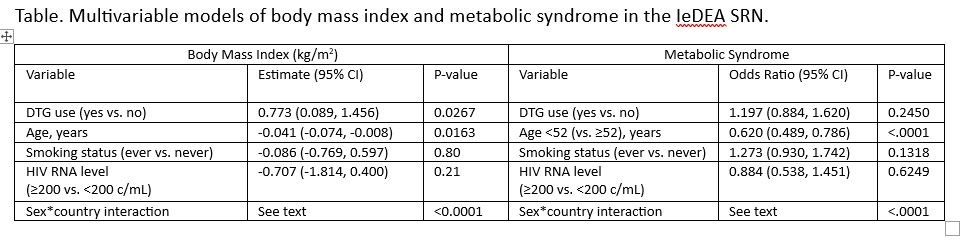
1446 participants from Brazil (N=212), Côte d’Ivoire (N=298), India (N=188), Kenya (N=77), Mexico (N=193), Togo (N=244), Uganda (N=100), and Zambia (N=134) were included. Overall, 54% were female, 94% had HIV-1 RNA <200c/mL, 53% were using DTG (78% for >6 mos), and median age was 50.5 years. Median BMI was 25.3 kg/m2, and 35% had MetS. DTG use and younger age were significantly associated with higher BMI (Table), with a significant interaction by sex by country. In India, females and males had similar BMI; in other countries BMI was similar among females and varied in males (higher in Brazil and Mexico and lower in in Kenya, Uganda, and Zambia). MetS was significantly associated with older age and again with significant interaction by sex by country. Compared to males, females had higher odds [adjusted OR (95% CI)] of MetS in Zambia [20.75 (2.71, 158.97)], Uganda [15.17 (4.69, 49.11)], Kenya [12.53 (2.55, 61.69)], Togo [4.31 (1.98, 9.36)], Côte d’Ivoire [3.21 (1.80, 5.74)], and Mexico [3.02 (1.18, 7.72)], but not in Brazil or India. No other interactions involving DTG use, sex, and country were associated with BMI or MetS.
Conclusions:
DTG was associated with modestly higher BMI but not with MetS in the IeDEA SRN cohort. These data suggest cardiometabolic risk varies across low- and middle-income settings and is dependent on age, sex, and country.