Background:
Epigenetic modifications may highlight mechanisms through which HIV and antiretroviral therapy (ART) exposure during critical developmental periods affect biological pathways and disease risk. We examined if perinatally-acquired HIV is associated with genome-wide alterations in the DNA methylome by comparing youth living with perinatal HIV (YPHIV) and youth who are perinatally HIV-exposed uninfected (YPHEU) at two timepoints. Among YPHIV, we examined associations between viral load (VL), CD4 count, and markers of inflammation with genome-wide alterations in the DNA methylome.
Methods:
32 YPHIV and 7 YPHEU with peripheral blood mononuclear cell samples collected at two timepoints ≥3 years apart were selected from the US-based PHACS Adolescent Master Protocol. DNA methylation was assayed using the Illumina MethylationEPIC (850K) array. Using the limma package, we tested for differentially methylated (DM) CpG sites (FDR p-value <0.05 and ≥5% difference in methylation) between groups at each timepoint. 15 targeted genes identified from prior work (PMID: 31324826) were also assessed for DM CpG sites. Among YPHIV, genome-wide associations of cumulative VL, cumulative CD4, C-reactive protein [CRP], and Interleukin-6 [IL-6] with DNA methylation were adjusted for ART type and age at ART initiation.
Results:
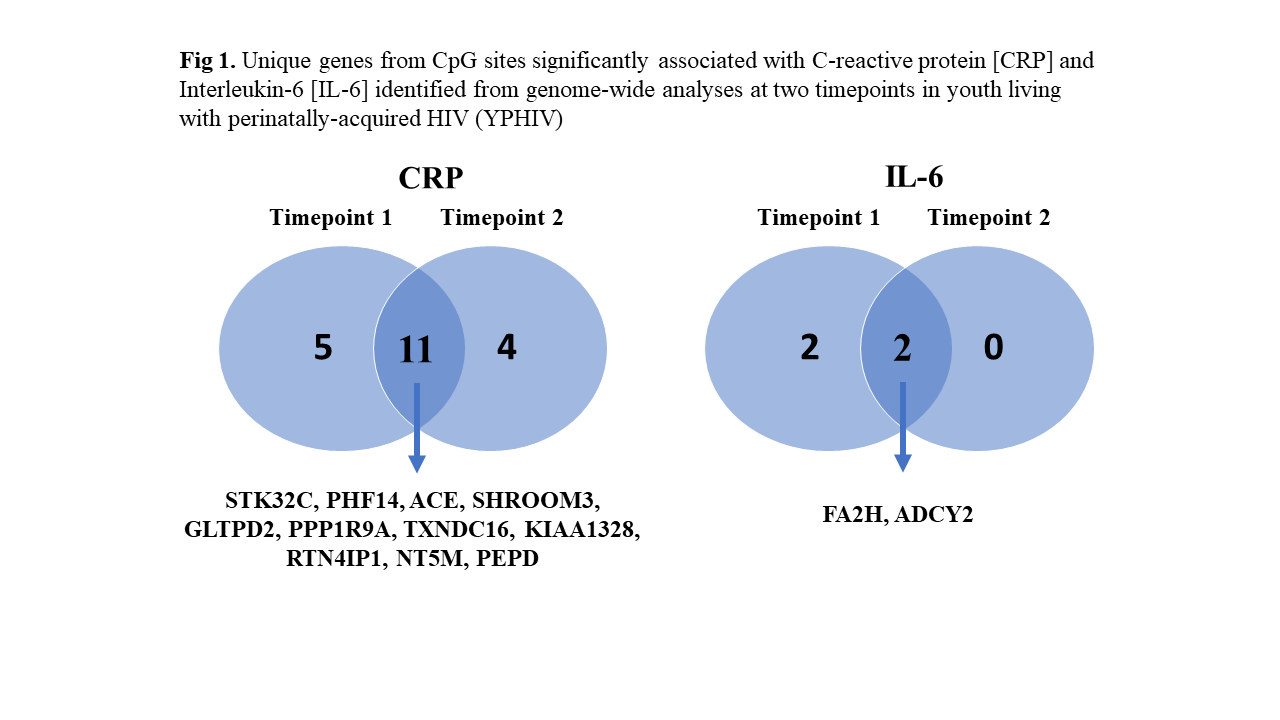
Overall, median age was 11 and 17 years at timepoints 1 and 2, respectively. Groups were balanced by sex (51% male) and race/ethnicity (64% non-Hispanic Black). Genome-wide, there were no DM sites comparing YPHIV to YPHEU at either timepoint. For targeted genes, 1 CpG site on SPERT and 6 CpG sites on PSMB9 were DM at timepoint 1 comparing YPHIV to YPHEU. At timepoint 2, 10 CpG sites on PSMB9 and 4 CpG sites on EBF4 were DM comparing YPHIV to YPHEU. Among YPHIV, cumulative VL or CD4 count were not associated with any CpG sites. CRP was associated with 27 CpG sites (16 genes) at timepoint 1 and 19 CpG sites (15 genes) at timepoint 2, with 11 genes overlapping timepoints (Fig 1). IL-6 was associated with 6 CpG sites (4 genes) at timepoint 1 and 2 CpG sites (2 genes) at timepoint 2, with 2 genes overlapping timepoints (Fig 1).
Conclusions:
Associations between markers of inflammation and epigenetic signatures among genes involved in blood pressure regulation, chronic kidney disease, and fatty acid processing were detected in YPHIV at two timepoints in childhood/adolescence. These genes may provide insight into inflammatory pathways contributing to HIV-associated chronic comorbidities among YPHIV.