Background:
Understanding antiretroviral therapy (ART)-independent control of HIV is of paramount importance and central for HIV cure. Some people living with HIV spontaneous regulate viral replication without ART and are categorized into ‘elite controllers’ (EC, HIV-RNA <50 c/mL) and 'viremic controllers' (VC, HIV-RNA between 50-10,000 c/ml). EC or VC may eventually lose controller status (HIV-RNA >10,000 copies/mL) and become transient controllers (TC), in contrast to persistent controllers (PC). Exploring plasma protein profiles of controllers that transition to TC may discern the intricacies of HIV pathogenesis and may ultimately yield new treatment strategies. Our aim was to scrutinize whether circulating proteins of EC and VC at baseline were associated with loss and/or sustained viral control.
Methods:
The Dutch national ATHENA cohort provided baseline blood samples from 36 ECs and 145 VCs, maintaining control status for >5 years. Serial viral load (VL) measurements were documented for up to 17 years. Expression of 3072 plasma proteins was measured using proximity extension assay coupled with next-generation sequencing, with 2420 proteins used for analysis after quality control. Only one EC lost control during follow-up; analysis was therefore applied on VC only.
Results:
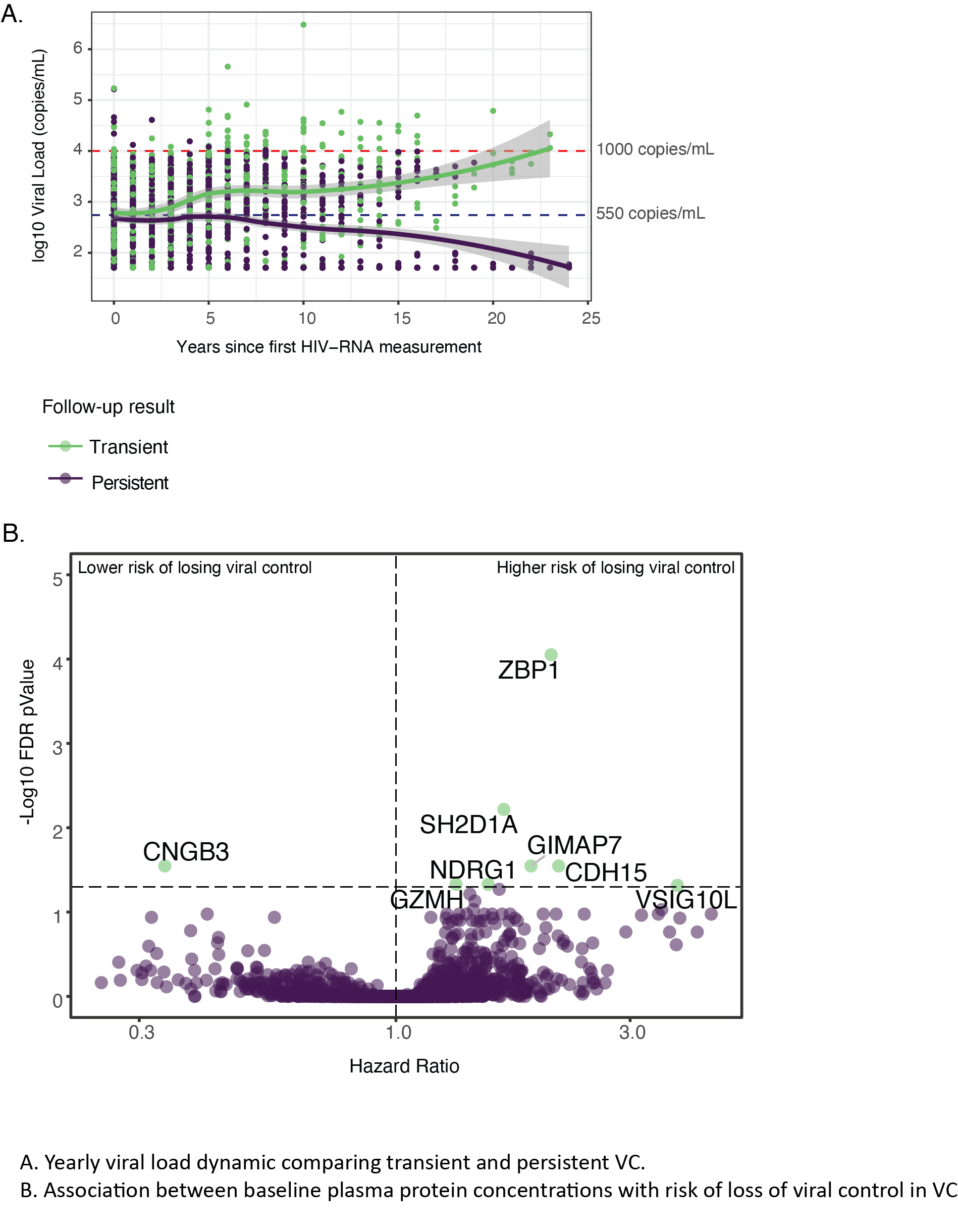
Loss of controller status occurred in 38% (55/145) of VCs after a median of 8.5 years. TC had similar demographics (age, sex, BMI, ethnicity), smoking status, and latest CD4 and VL compared to PCs. However, elevated initial VL was noted in TCs (median [Interquartile range] TCs 1347 [245, 4271] vs. PCs 443 [50, 1912.5] c/ml). Over time, TC exhibited an annual increase in VL by 1375 c/mL, while PCs exhibited stable VL. Proteomic analysis identified seven proteins (ZBP1, SH2D1A, CDH15, GIMAP7, VSIG10L, NDRG1, GZMH) associated with a higher risk of losing VC status, whereas CNGB3 was linked to a lower risk, observed over a median period of 4.2 years before loss of HIV control. Notably, certain proteins (SH2D1A, NDRG1) have been implicated in other viral infections, yet their association with HIV infections is scarce or absent in existing literature.
Conclusions:
Several years before loss of spontaneous viral control, TC exhibited the upregulation of plasma proteins with known immune and cellular functions, including inflammation, apoptosis, and cell adhesion. Our findings advance our understanding of ART-independent control mechanisms, underscoring the prospect of identifying early biomarkers for impending loss of HIV control.