Background:
Elite Controllers (EC) are PLWH that present drug-free control of the infection, representing a model for a functional cure. Hence, understanding their mechanisms of immune-mediated control is of considerable interest. We sought to characterize the NK cell repertoire in EC, including their memory-like properties and functional potential.
Methods:
PBMC samples from n=33 EC (n=20 with durable control (DC), and n=13 with immunological aborted control (AC), defined by a progressive CD4+ T cell depletion (p< 0.05) during the patient’s follow-up), n=25 healthy donors (HD), n=8 ART-suppressed (ART), and n=7 viremic (VIR) participants were included in the study. Phenotypic studies were performed by flow cytometry and included the markers CD57, CD56, Nkp30, NKG2C, NKG2A, CD16, CXCR3, KIR2DL2/L3, and KLRG1. Natural cytotoxicity and cell activation were evaluated by IFN-γ, CD107a, CD69 and HLA-DR expression by flow cytometry after co-culturing isolated NK cells with the MHC-devoid K562 cell line with and without IL-15. Antibody-dependent cell-mediated cytotoxicity (ADCC) was assessed after co-culturing NK cells with the latently-infected ACH-2 cell line and HIV+ plasma. P24 expression was measured by flow cytometry.
Results:
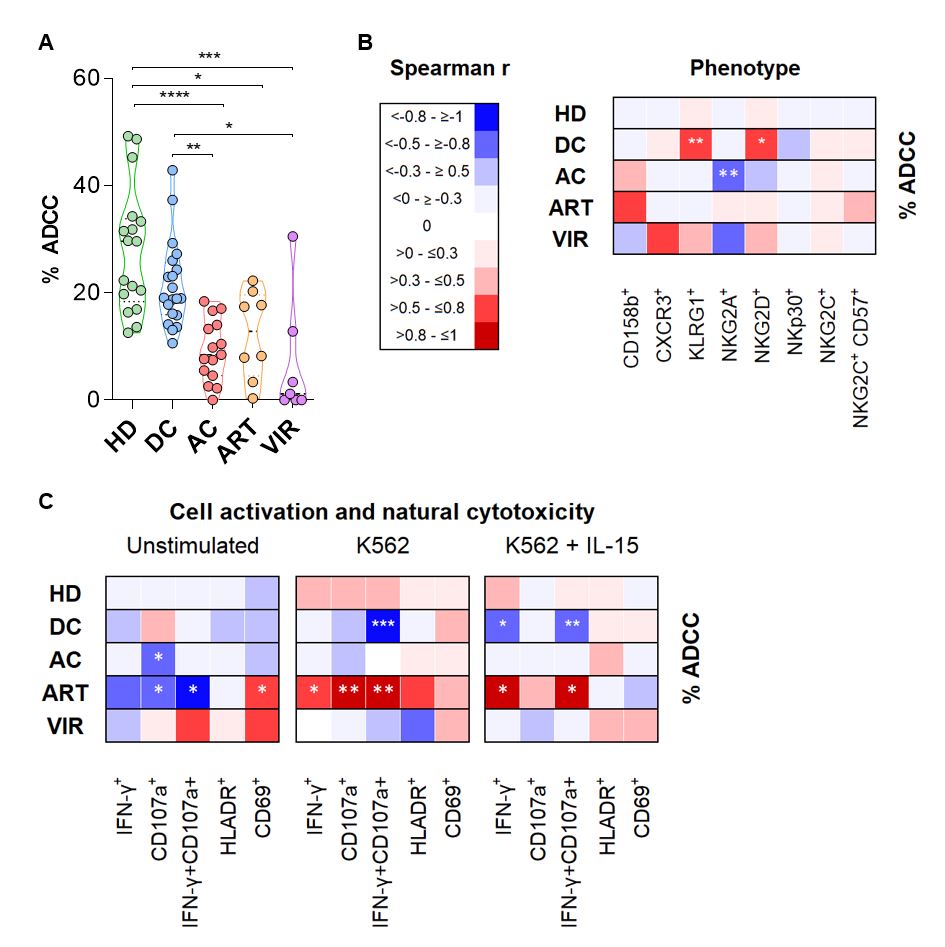
NK cells from DC presented lower NKG2A expression (p=0.004) and basal cell activation, based on HLA-DR (p=0.033) and CD69 (p=0.042) expression, compared to AC. In addition, NKG2C+ NK cells, associated to memory-like NK cells, were expanded in DC compared to HD and AC (pHD< 0.001 and pAC=0.040), and were found to produce higher basal IFN-γ levels than AC (p=0.024). Although NK cells from DC showed a marked cytotoxic response to K562 in the presence (p< 0.001) or absence of IL-15 (p< 0.001) compared to unstimulated conditions, the response was significantly lower compared to HD (pK562= 0.001, pIL-15=0.049). However, NK cells from DC showed a strong ADCC response, similar to HD. Importantly, DC presented a remarkable ADCC response compared to AC (p=0.003) and VIR (p=0.013) participants (Figure 1A), which correlated positively with KLRG1 (p=0.008, r=0.57) and NKG2D expression (p=0.016, r=0.52) and inversely with the cytotoxic response presented upon K562 (p< 0.001, r=-0.80) and IL-15 (p=0.003, r=-0.74) stimulation (Figure 1B).
Conclusions:
Our findings suggest that durable immune-mediated control of HIV infection in EC is defined by NK cell phenotypic and functional attributes, including lower cell activation, an increased memory-NK cell compartment and higher ADCC responses.
Figure 1. ADCC responses are associated to phenotypical and functional changes in the NK cell repertoire. (A) Summary graph of the ADCC activity mediated by NK cells from study groups in the presence of plasma from a viremic HIV+ participant. Statistical comparisons were performed using Kruskal-Wallis One-way ANOVA followed by Dunn’s multiple comparisons test. *p < 0.05, **p < 0 < 01, ***p < 0.001, ****p < 0.0001. (B-C) Heatmaps summarizing the correlations between ADCC responses and (B) NK cell receptor expression (left to right: CD158b, CXCR3, KLRG1, NKG2A, NKG2D, Nkp30, NKG2C and CD57) in CD56total NK cells or (C) functional markers (IFN-γ, CD107a, HLA-DR and CD69) in (left to right): unstimulated, K562-stimulated and IL-15-K562-stimulated CD56total NK cells by study group. Statistical analysis was performed using two-tailed spearman rank correlation. *p < 0.05, **p < 0 < 01, ***p < 0.001