Background:
This study investigated the longitudinal antibody response profiles and their durability after administering various COVID-19 vaccines to a subset of the Ugandan population within Sub-Saharan Africa (SSA). The hypothesis was that these profiles in SSA may exhibit unique characteristics due to genetic, environmental, or serological variations, thereby addressing significant gaps in global datasets and contributing insights specific to response patterns within this demographic.
Methods:
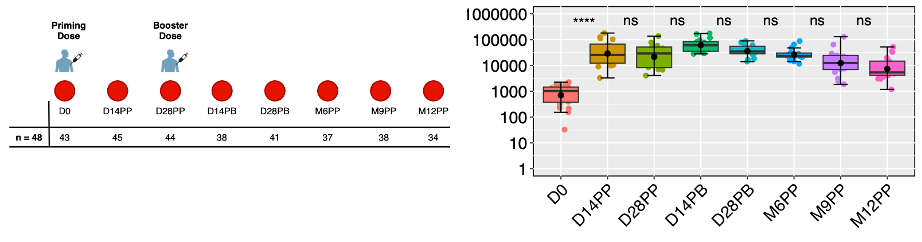
Participants were enrolled to assess the temporal evolution and persistence of antibody responses for 12 months post-initial vaccination. These included 48 individuals vaccinated with Pfizer, 67 with AstraZeneca, and 21 with Moderna, all receiving two doses 28-30 days apart. Additionally, 60 participants who received the Sinovac vaccine were included, with their doses administered three months apart. A validated enzyme-linked immunosorbent assay (ELISA) was used to measure concentrations and optical densities (ODs) of SARS-CoV-2-specific IgG, IgM, and IgA binding antibodies. The OD threshold values for determining antibody positivity in this population were S-directed IgG at 0.432, IgM at 0.459, and IgA at 0.226. Statistical analyses included box plots, diverging bar graphs, and the Wilcoxon test with a Bonferroni correction for multiple analysis.
Results:
All four vaccines demonstrated a significant increase in Spike-directed IgG antibody concentrations within 14 days of the initial vaccine dose declining by six months, mirroring global observations. A significant observation was the lack of the anticipated surge in S-IgG levels following the booster dose. This trend starkly contrasted findings noted in various other global populations. The S-IgM response was transient and mostly subsided below the established thresholds, illustrating its initial early emergence and subsequent decline. S-IgA highlighted the temporal dynamics of mucosal immunity, showing an initial increase and then a reduction by six months post-vaccination. Breakthrough infections occurred at similar levels across all vaccines studied; however, they were all asymptomatic.
Conclusions:
These data emphasise the critical need for inclusion of region-specific research to formulate vaccination strategies attuned to regions like SSA’s unique environmental, genetic, and serological landscapes, ensuring the development of relevant vaccination policies.