Background:
The CDC recommends the 2-dose JYNNEOS vaccine for protection against mpox for people with HIV (PWH) due to a high proportion of US mpox cases occurring in PWH and an increased risk of severe mpox disease among those with uncontrolled HIV infection. In Los Angeles County (LAC), 45% of mpox cases have occurred in PWH, primarily among cis-men and transgender persons. We aim to identify demographic and health-related predictors of JYNNEOS vaccination among cis-men and transgender PWH in LAC.
Methods:
Cis-men and transgender adults aged ≥ 18 years with diagnosed HIV in LAC were included. Unvaccinated PWH with a prior mpox diagnosis were excluded. Potential predictors of JYNNEOS vaccination included: demographics, viral suppression, CD4 count, HIV transmission mode, receipt of HIV care (past 12 months), retention in HIV care*, recent STI (in 2021), and ≥ 1 prior COVID-19 vaccination (proxy for individual vaccine confidence). Fully nonproportional odds models were used to measure the associations between predictor variables and the outcome (2, 1 or 0 doses of JYNNEOS).
Results:
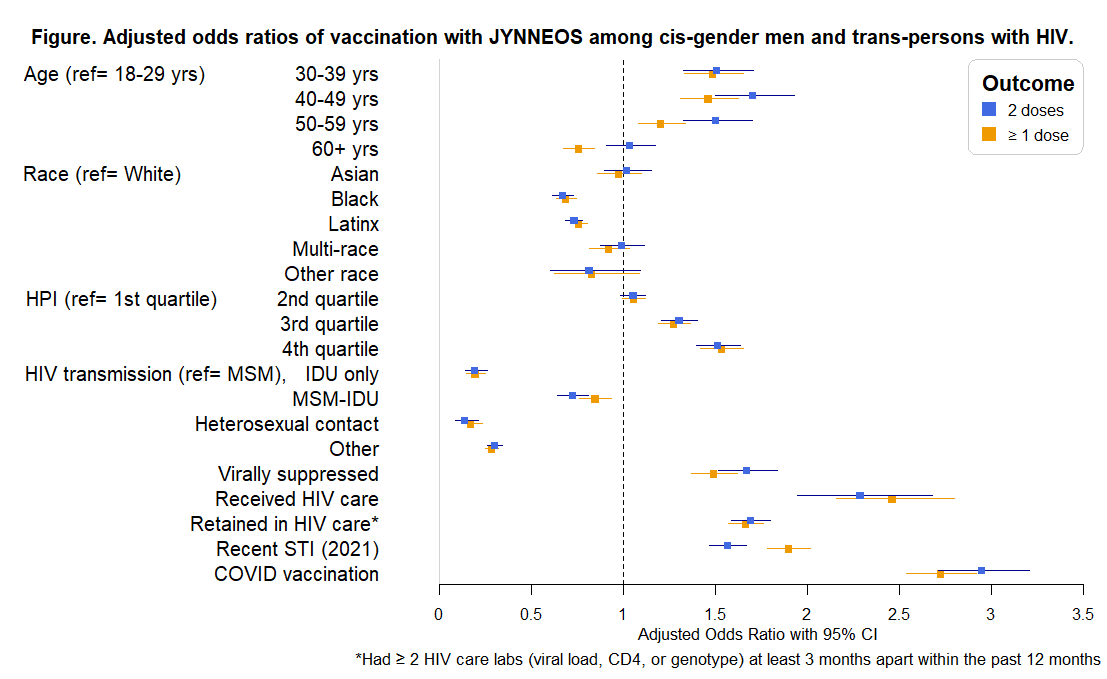
Among 37,613 cis-men or transgender PWH, 8,757 (23.3%) were fully vaccinated, 3,473 (9.2%) had received 1 dose, and 25,383 (67.5%) were unvaccinated. Disparities by age group, race/ethnicity, and healthy places index (HPI) were observed. Full vaccination was lowest among PWH who were aged 18-29 (14.5% vs 26.2% aged 40-49), Black (17% vs 30.3% Asian and 28.8% White), or living in zip codes in the lowest quartile of HPI (20% vs 31% highest). Prior COVID vaccination (adjusted odds ratio [aOR] 2.9, confidence interval [CI] 2.7-3.2), receipt of HIV care in the past 12 months (aOR 2.3, CI 1.9-2.7), recent STI diagnosis (aOR 1.6, CI 1.5-1.7), and living in the highest HPI quartile (aOR 1.5, CI 1.4-1.6) were significant predictors of JYNNEOS vaccination (Figure). Black (aOR = 0.67, CI: 0.62-0.73) and Latinx (aOR = 0.73, CI: 0.68-0.78) PWH were less likely to be fully vaccinated against mpox compared to White PWH.
Conclusions:
Patients engaged in HIV care or who had a recent STI diagnosis were significantly more likely to receive the JYNNEOS vaccine; this may be attributable to vaccine receipt during an HIV/STI visit or underlying individual healthcare seeking behaviors. These findings also highlight the importance of tailoring vaccine outreach efforts to improve vaccine confidence and access, especially for younger individuals, underserved neighborhoods, and Black and Latinx communities.