Background:
Clinical trials have shown that dolutegravir (DTG)-containing antiretroviral therapy results in larger weight gains than other antiretroviral therapies (ARTs). Not all people are expected to have the same risk for increased weight gain with DTG-containing ARTs. Discovering subgroups for whom DTG is more likely to cause substantial weight gain allows treatment recommendations to be tailored to a person’s risk profile.
Methods:
We developed the Subgroup Discovery for Longitudinal Data (SDLD) algorithm, a data-driven tree-based algorithm that combines modern machine learning and causal inference methods for discovering subgroups with heterogeneous treatment effects using longitudinal data. We applied the algorithm to electronic health records (EHRs) from the Academic Model Providing Access to Healthcare (AMPATH) partnership in Eldoret, Kenya to discover subgroups who are at higher risk of weight gain when on DTG-containing ARTs.
Results:
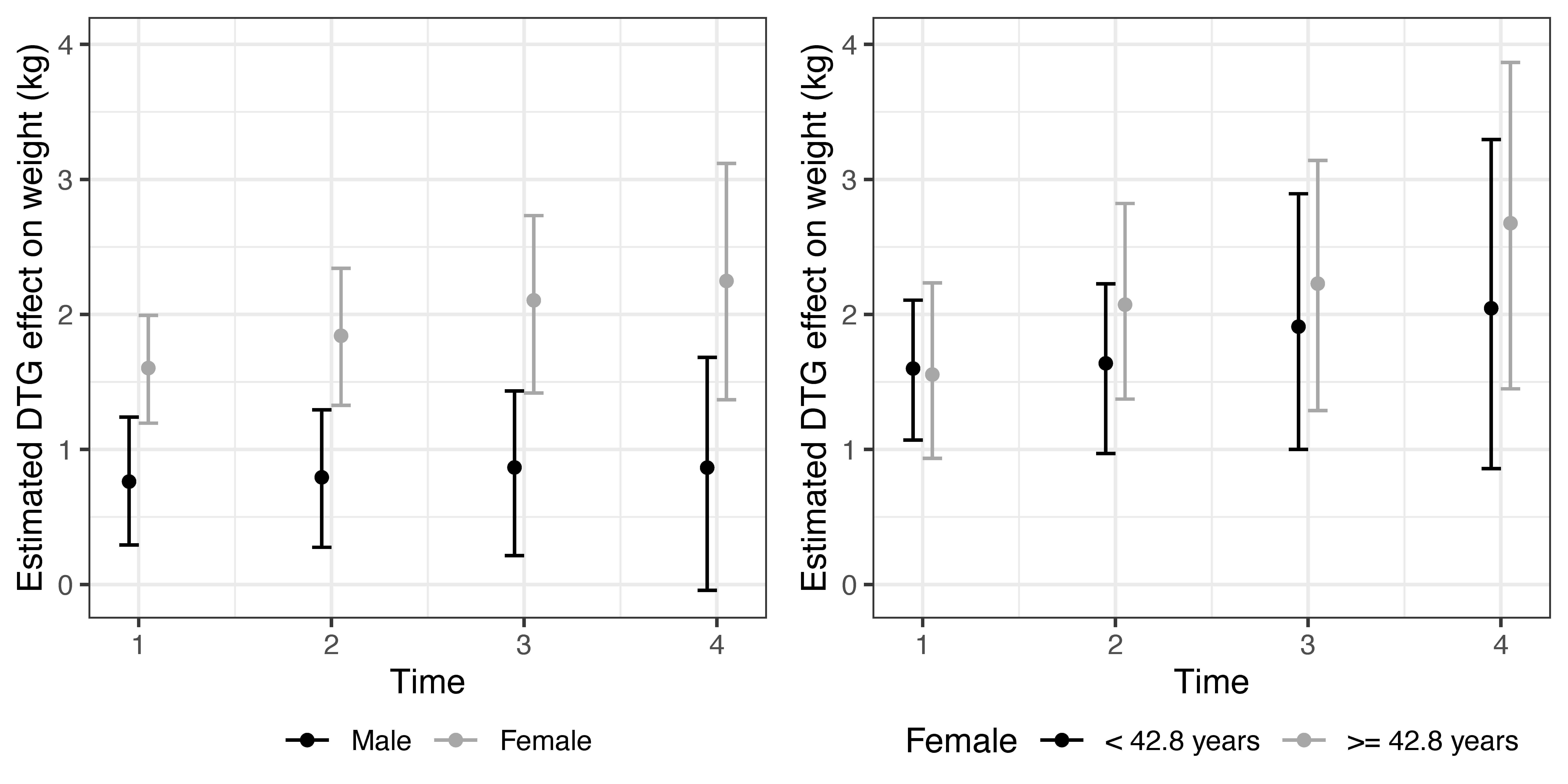
A total of 84,445 individuals who were at least 18 years old, were initiating or on ART, and had data on or after July 1, 2016 with 1,178,016 unique clinic visits were included. The average causal effect on 1,000-day weight gain was 1.41 kilograms (kg) higher comparing always to never on DTG-containing ARTs (95% confidence interval (CI) [0.99, 1.82]). After searching over a large space of subgroups, the SDLD algorithm identified gender as the primary source of heterogeneity in DTG effects and the average weight gain in 1,000 days when always on a DTG-containing ART was larger for females (2.25 kg, 95% CI [1.37, 3.12]) than males (0.87 kg, 95% CI [-0.04, 1.68]). The algorithm further split the female subgroup into whether they were older than or equal to 42.8 years old or not with older females having higher estimated weight gain. The figure shows the estimated weight trajectories among the subgroups.
Conclusions:
We developed a novel algorithm that combines modern machine learning and causal inference methods to discover subgroups with heterogeneous treatment effects. We applied the algorithm to a large EHR database on people living with HIV in western Kenya. Our findings are consistent with prior research showing larger weight gains associated with DTG-containing ARTs. Gender was found to be the primary source of heterogeneity when we applied the first data-driven discovery of subgroups with larger weight gain when on DTG-containing ARTs.
Estimated weight trajectories among subgroups with differential weight gain when taking dolutegravir