Background:
Hepatitis C virus (HCV) infection is a leading cause of hepatocellular carcinoma (HCC). While direct-acting antivirals (DAA) cure ~95% of individuals with HCV, precise estimates of HCC risk and of risk trends post-DAA are urgently needed to inform HCC surveillance. We aimed to estimate the effect of DAA treatment on HCC risk in people with HIV/HCV co-infection and advanced liver fibrosis or cirrhosis.
Methods:
We emulated a target trial using data on individuals with HIV/HCV from HepCAUSAL, a collaboration of 12 cohorts from Europe and North America. The eligibility criteria were: HIV infection, chronic HCV infection, advanced liver fibrosis or cirrhosis (clinical cirrhosis diagnosis, liver stiffness ≥9.5 kPa, or FIB-4 ≥3.25), DAA naïve, HIV-RNA <200 copies/mL, on antiretroviral therapy, no hepatitis B virus co-infection, and no previous HCC diagnosis or liver transplant. The treatment strategies were DAA initiation versus no DAA use during the follow-up. The outcome was incident HCC. We emulated a sequence of trials starting each month between Jan 2013 and Dec 2022 and individuals could be eligible in and contribute follow-up to multiple trials. We censored individuals in the no DAA group if/when they initiated DAA. We estimated the 4-year cumulative incidence of HCC under the two DAA strategies with adjustment for confounding and loss to follow-up via inverse probability weighting.
Results:
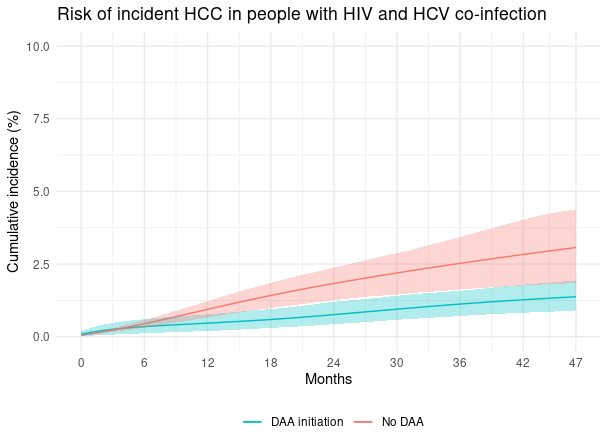
Of 3,871 eligible individuals (87% males, median age of 56 [IQR: 50,61]), 71% initiated DAAs and 108 had an incident HCC diagnosis. These individuals contributed on average to 19 trials. The estimated 4-year HCC risk was 1.37% (95% CI: 0.90, 1.94) in the DAA group and 3.07% (95% CI: 1.84, 4.38) in the no DAA group, corresponding to a risk difference of -1.69% (95% CI: -3.16, -0.20) and a risk ratio of 0.45 (95% CI: 0.24, 0.89). In the DAA group, the risk of HCC was approximately constant over time (Figure) with a mean annual incidence of 0.35% (95% CI: 0.17, 0.59).
Conclusions:
We estimated that DAA reduces the 4-year HCC risk by 2% on an absolute scale and 55% on a relative scale in people with HIV/HCV co-infection and advanced fibrosis or cirrhosis. The annual HCC risk after DAA initiation was close to the threshold (0.4%) beyond which HCC surveillance is deemed cost-effective, which suggests that continued post-cure HCC monitoring is warranted in this population.