Background:
Central nervous system (CNS) dysfunction is a common consequence in people with HIV (PWH). Understanding of the impact of HIV on the brain remains limited to select cell types and regions. We describe preliminary efforts to establish cell-type specific gene expression patterns across multiple regions in PWH using single cell transcriptomics.
Methods:
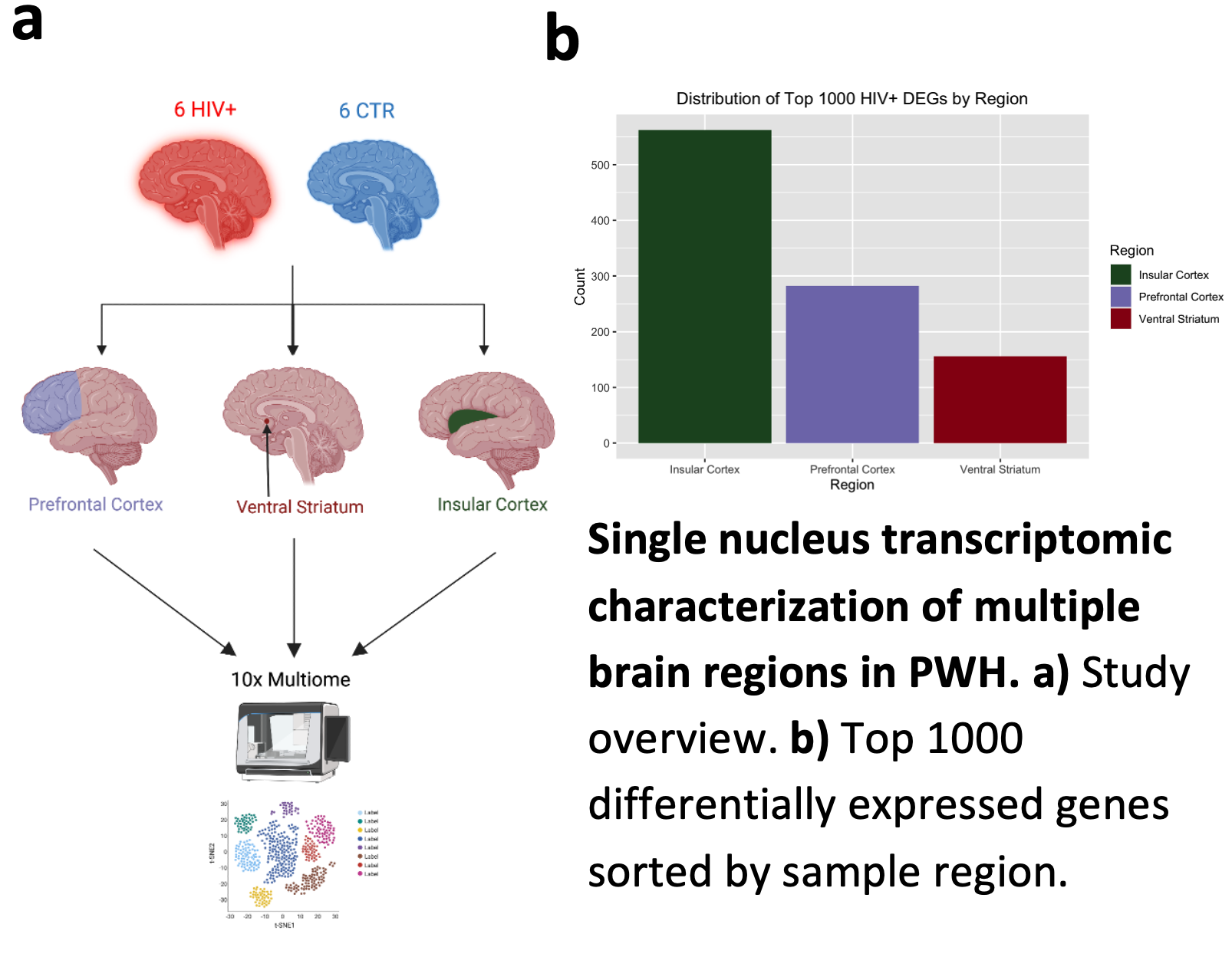
Nuclei were isolated from frozen post-mortem tissue from insular cortex (INS), prefrontal cortex (PFC), and ventral striatum (VST) from 6 PWH and 6 HIV-negative control (CTR) donors. We profiled transcriptomes and chromatin accessibility profiles of these 36 samples using 10x Genomics Chromium Single Cell Multiome ATAC+Gene Expression. In total, we analyzed single-cell transcriptomes of 144,918 cells from PWH and 153,868 cells from CTR. An integrated single cell t-SNE embedding was created for each region, and cells were clustered using Louvain. These clusters were then manually annotated to identify major cell types. We also performed pseudobulk differential expression (DE) analysis between PWH and CTR within major cell types and regions using EdgeR.
Results:
PWH and CTR donors were similar in age (median 45 and 39 years) and gender (33% vs 17% female) (p>.1). Canonical neuronal and non-neuronal cell types were detected in all regions. However, a population of putative T-like cells expressing CD247 and SKAP1 was identified in INS of 6 CTR and 5 HIV donors, with >80% of cells annotated as T-like originating from PWH. Consistent with their role as resident immune cells of the CNS, microglia exhibited the largest gene expression changes in PWH, including upregulation of pathways related to cytokine signaling and innate immunity. On the other hand, many genes were significant on DE analysis (p ≤.05) across all regions (151 PWH, 55 CTR) and multiple cell types (567 PWH, 974 CTR). For example, SERPINA3 was differentially expressed in PWH in INS, VST, and PFC by astrocytes, endothelial cells, neuronal cells, oligodendrocyte precursor cells, oligodendrocytes, microglia, and pericytes. Despite these widespread trends, 562 of the top 1000 significant results were genes differentially expressed in INS.
Conclusions:
We identified patterns of differential cell type abundance and gene/pathway expression in PWH. While our findings are consistent with previous single cell observations of glial cell involvement in PWH, our results indicate that many other cell types are affected by HIV and implicates the INS as a significant region for future exploration.