Background:
Transgender women (TW) face unique challenges staying engaged with HIV prevention services, including pre-exposure prophylaxis (PrEP). To inform efforts to increase PrEP retention among TW, we examined barriers to and facilitators of PrEP retention among TW in Southern California.
Methods:
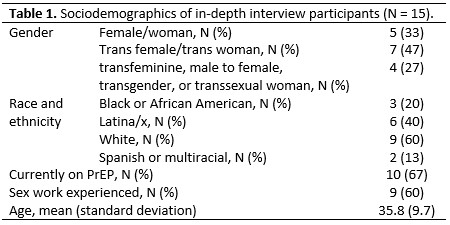
We used a mixed methods sequential explanatory approach with 2 phases. In Phase 1, we used quantitative data from a PrEP demonstration project (iMPrEPT) that included PrEP provision among 170 TW to evaluate 24-week retention by sociodemographics, engagement in sex work, substance use, and hormone replacement therapy (HRT) use. In Phase 2, we conducted 15 in-depth interviews with PrEP experienced TW purposively sampled to include TW who engaged in sex work based on Phase 1 findings. We then used thematic analysis to explain Phase 1 findings and integrated them in the presentation of Phase 2 themes.
Results:
In Phase 1, a greater proportion of participants who were not retained at 24 weeks reported engaging in sex work than those who were retained (18% vs 7%). In Phase 2, two subcategories of sex work engagement emerged. The first was characterized as engaging in “non-survival sex work” – these TW had little difficulty staying in PrEP care, sought clients from online sources, had stable housing, accessed HRT through providers, and exchanged sex primarily for money. The second was characterized as engaging in “survival sex work” – these TW struggled to stay in PrEP care, had street-based clients, were unstably housed, used black market hormones, and more frequently exchanged sex for drugs. In Phase 1, a smaller proportion of participants not retained at 24 weeks reported HRT than those who were retained (56% vs 71%). In Phase 2, participants consistently prioritized HRT over PrEP, describing HRT as a basic necessity and life-saving, yet many also described the bidirectional benefits of accessing HRT and PrEP. In Phase 1, a greater proportion of participants who were not retained at 24 weeks reported substantial or severe drug use than those who were retained (18% vs 8%). In Phase 2, participants reported drug use as a barrier to PrEP, often in the context of sex work.
Conclusions:
TW who engage in “survival sex work” experience barriers to PrEP retention (e.g., unstable housing, drug use) which may require supportive resources to stay engaged with PrEP care. The reciprocal benefits of HRT and PrEP suggest that co-location of services may be an optimal strategy for enhancing PrEP retention among TW.