Background:
Jail bookings represent an important opportunity for diagnosis and care linkage for people living with HIV (PLWH). However, jurisdictional data protections and decentralization of facilities can make connecting public health resources to correctional programs challenging. The purpose of this study was to evaluate the use of a novel approach using data scraping of publicly available jail inmate data to develop a real-time dataset of public jail rosters and to estimate the number of PLWH who have regular interactions with jails in Washington State (WA).
Methods:
We developed scripts to collect public-facing online jail rosters from local and tribal facilities in WA using R software. Between 11/14/2022 and 8/13/2023, we ran these scripts daily and developed a longitudinal database of the incarcerated population. We used a deterministic matching algorithm to link this database to the state HIV registry (as of 7/1/2023) using name, date of birth, and county of residence. We described the population that was jailed by demographic characteristics and CDC-defined viral suppression status on 12/31/2022. We used a zero-truncated Poisson model to estimate the total population of PLWH who are jailed on a regular basis and the subset of this population who was not virally suppressed.
Results:
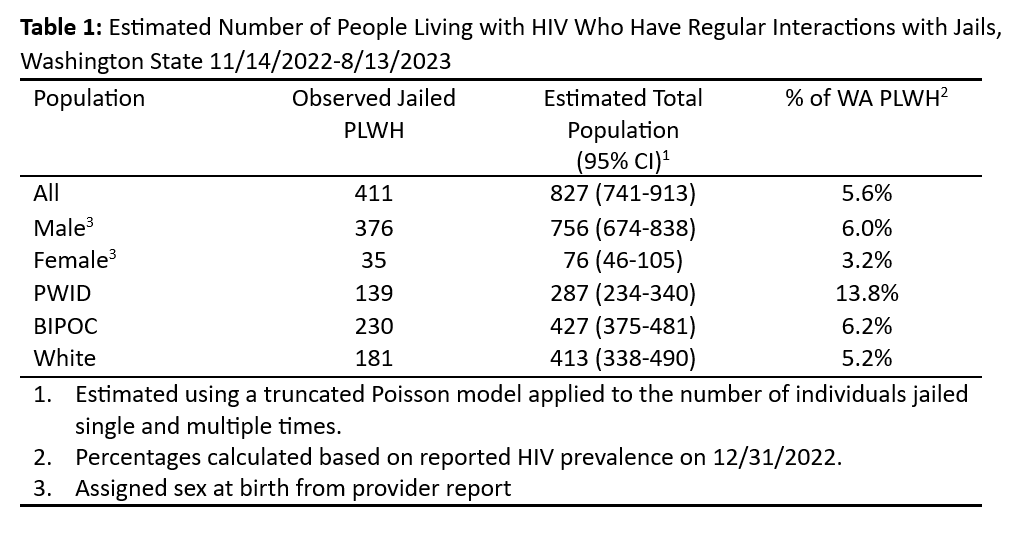
We successfully captured data from 57 of the 59 jails identified by the authors in WA. The remaining two jails were small county facilities which were not in compliance with state reporting requirements. In the 9-month study period, we collected 2,270,716 person-days of incarceration data representing 79,088 individuals. We identified 411 PLWH in this population who were jailed 573 times. We estimate that this is a subset of a population of 827 PLWH (95% CI 741-913) who are regularly jailed, which represents 6% of the 14,872 PLWH living in WA (Table 1). Of the 411 identified PLWH, 135 were not virally suppressed (33%, estimated population size: 253, 95% CI 212-294).
Conclusions:
Public facing jail registries can be used to describe the intersection of PLWH and the criminal legal system and to identify the location of PLWH who are not virally suppressed. Public health programs looking to increase their ability to reach justice-involved populations may consider whether public-facing jail rosters could be a useful data source.