Background:
In elite controllers (EC) and people on very long-term antiretroviral therapy (ART), the integration sites of intact HIV proviruses become skewed towards transcriptionally inactive genomic loci. Understanding the mechanisms that select for integration sites in gene-distal loci that are refractory to reactivation is key towards developing strategies for functional HIV cures. We devised a novel in vivo model to test whether sustained CD8 T cell pressure would be sufficient to recapitulate these integration site profiles.
Methods:
NSG mice were engrafted with memory CD4 T cells from a human cisgender male HLA-B27+ controller with or without autologous CD8 T cells. Viral loads and flow cytometry were performed weekly including HLA-B27+ KK10 (Gag) tetramer staining. Eight weeks post infection with HIVJRCSF, human CD4 T cells were quantified in spleens by flow cytometry (Gag+) and the intact proviral DNA assay (IPDA). Proviral integration site isolation and sequencing was performed using ligation-mediated PCR. Integration sites were then identified using the AAvengeR software pipeline. We investigated the association of integration sites with various genomic features, including epigenetic marks, inferred nuclear localization markers, and catalogs of gene expression.
Results:
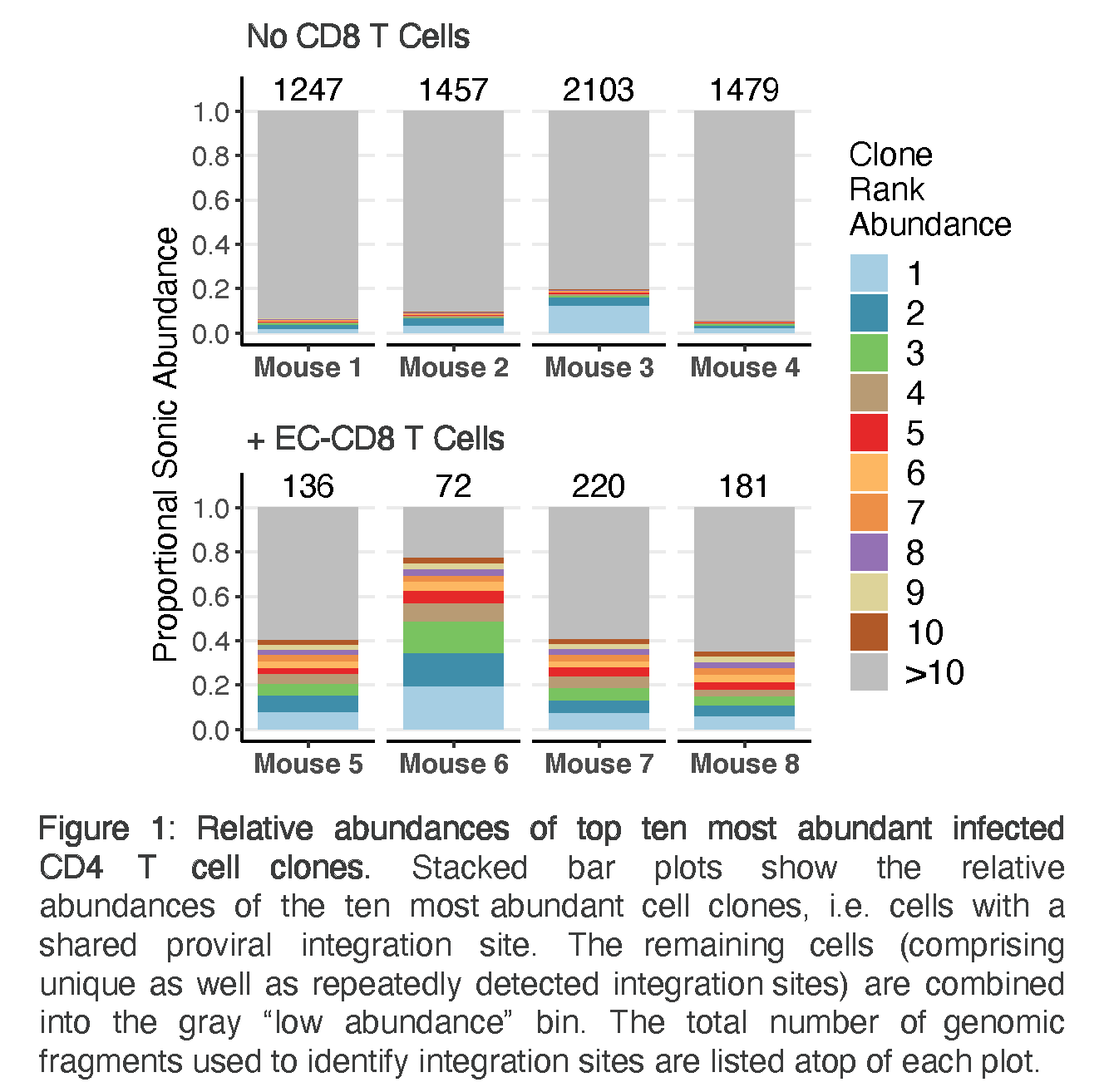
KK10-specific cells expanded to >20% of CD8 T cells, driving sustained 2-3 log reductions in viral load without immune escape. The ratio of Gag protein-expressing to intact provirus-harboring cells was reduced in +CD8 mice compared to –CD8 mice – consistent with selection for latency (p=0.027). This was associated with a clear footprint on the proviral integration site landscape with enrichment of integrations: 1. Outside of genes (p=0.018), 2. Further away from genes (p< 0.001), 3. Closer to the nuclear periphery (p=0.01) and 4. With the provirus in opposite orientation relative to host gene transcription (p=0.002, odds ratio 0.64). The total diversity of integration sites was decimated in the presence of CD8 T cells leaving predominately expanded clones; 10 clones constituted 32-76% of infected cells. No significant differences were observed in the percentages of intact HIV proviruses between +CD8 and –CD8 mice (IPDA, p=0.209).
Conclusions:
Our findings validate the idea that CD8 T cells can shape the integration site landscape by selecting for latent proviruses and describe a precise signature of this footprint. This mirrors features seen in ECs and provides guidance for interpreting the impacts of clinical interventions.