Background:
Antiretroviral therapy (ART) has substantially reduced the risk for serious central nervous system (CNS) complications in chronic HIV infection, but milder forms of neurocognitive impairment have been described in people living with HIV (PLWH) using ART. Intrathecal immune activation is a key component in HIV-associated CNS injury in advanced untreated infection, while the importance of the residual, low grade CNS inflammation seen during ART is less clear. The immune activation is initiated by the virus, but secondary immunological mechanisms may contribute to the inflammatory process.The complement system is involved in the pathogenesis of other inflammatory CNS conditions, but the importance in HIV-associated CNS infection, as well as the potential impact of ART is less well characterized. The aim of this study was to explore evidence of complement activation in CSF in untreated HIV infection and in PLWH on ART.
Methods:
Retrospective cross-sectional study including PLWH on (HIV-ART) or off (HIV-untreated) ART monitored in a standardized CSF sampling protocol, and 28 HIV-negative controls (no evidence of CNS infection in clinical lumbar puncture). Complement factor B (CFB), C1q, C3a, C4b2a, C5, C5a and C3b was analyzed by commercial ELISA (complement) or immunoassay (neopterin). CSF NfL was analyzed by in-house ELISA.
Results:
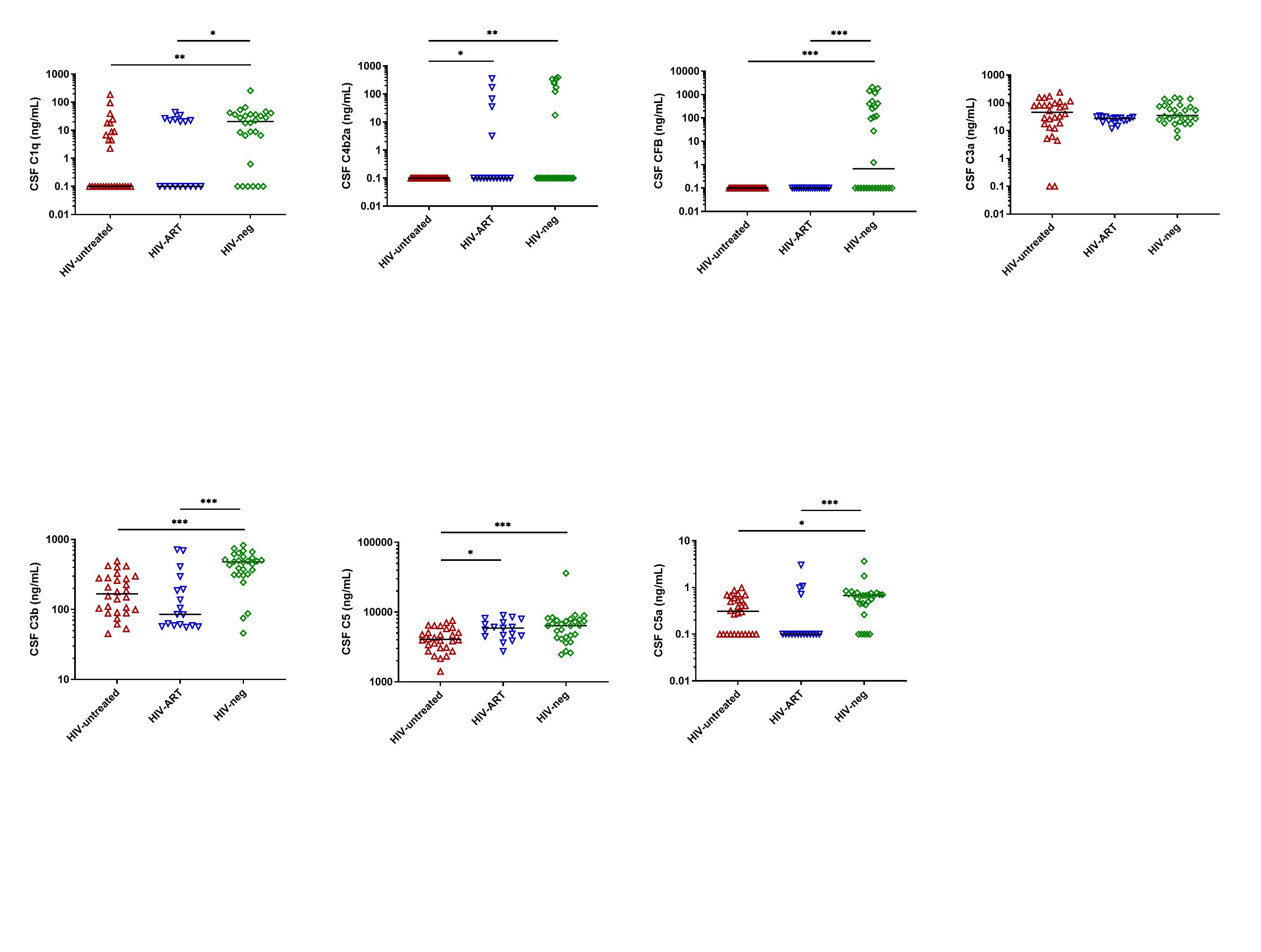
Forty-five (26 male) PLWH (were included in the study; 17 (9 male) were on ART (plasma HIV-RNA < 20 copies/mL). Significant differences in CSF complement concentrations were seen between HIV-untreated and controls in C1q (p=.004), C4b2a (p=.003), CFB (p=< .001), C3b (p=< .001), C5 (p=.001) and C5a (p=.02), but not C3a (p=.3), between HIV-ART and controls for C1q (p=.05), CFB (p=< .001), C3b (p=< .001) and C5a (p=< .001), and between HIV-untreated and HIV-ART for C4b2a (p=.03), C5 (p=.02). CSF neopterin was significantly correlated to C1q (r=.63; p< .001), C3b (r=.47; p=.01) and C5 (r=.56; p=.002) in PLWH without, but not on, ART.
Conclusions:
Different patterns were found in PLWH compared to controls in CSF complement activity in all activation pathways (classic, alternative, lectin) as well as the terminal cascade. Correlation to macrophage/microglial activation was seem only in untreated PLWH. ART appeared to reduce, but not eliminate, complement activity in CSF. Although the clinical significance of residual intrathecal immune activation needs further study, complement activity may potentially contribute to the CNS pathogenesis in HIV.
CSF complement factor concentrations