Background:
Cryptococcal meningitis (CM) remains a frequent opportunistic infection among individuals living with advanced HIV disease (AHD) in much of Africa. Despite widespread expansion of ART programmes, modelled estimates indicate that the incidence of CM has not substantially decreased between 2014 and 2020, suggesting that the prevalence of AHD remains high in the region. CM incidence could provide a useful indicator for monitoring AHD rates and HIV program success, especially in the context of declining access to CD4 testing; most patients present to healthcare facilities with a well-defined clinical syndrome, and diagnosis can be made using low-cost and highly accurate rapid diagnostic tests. Very few countries collect reliable statistics on CM incidence, and the impact of WHO universal HIV treatment guidelines on the incidence of AHD is not known.
Methods:
We analyzed 8 years of national meningitis surveillance data (2015-2022) captured from electronic health records in Botswana. All laboratory records from cerebrospinal fluid samples analysed within government healthcare facilities in Botswana were extracted from a central online repository. Adjustments for missing data were made based on triangulation for underestimates using comprehensive prospective datasets. CM case frequency was enumerated using a case definition and incidence was calculated using national census data.
Results:
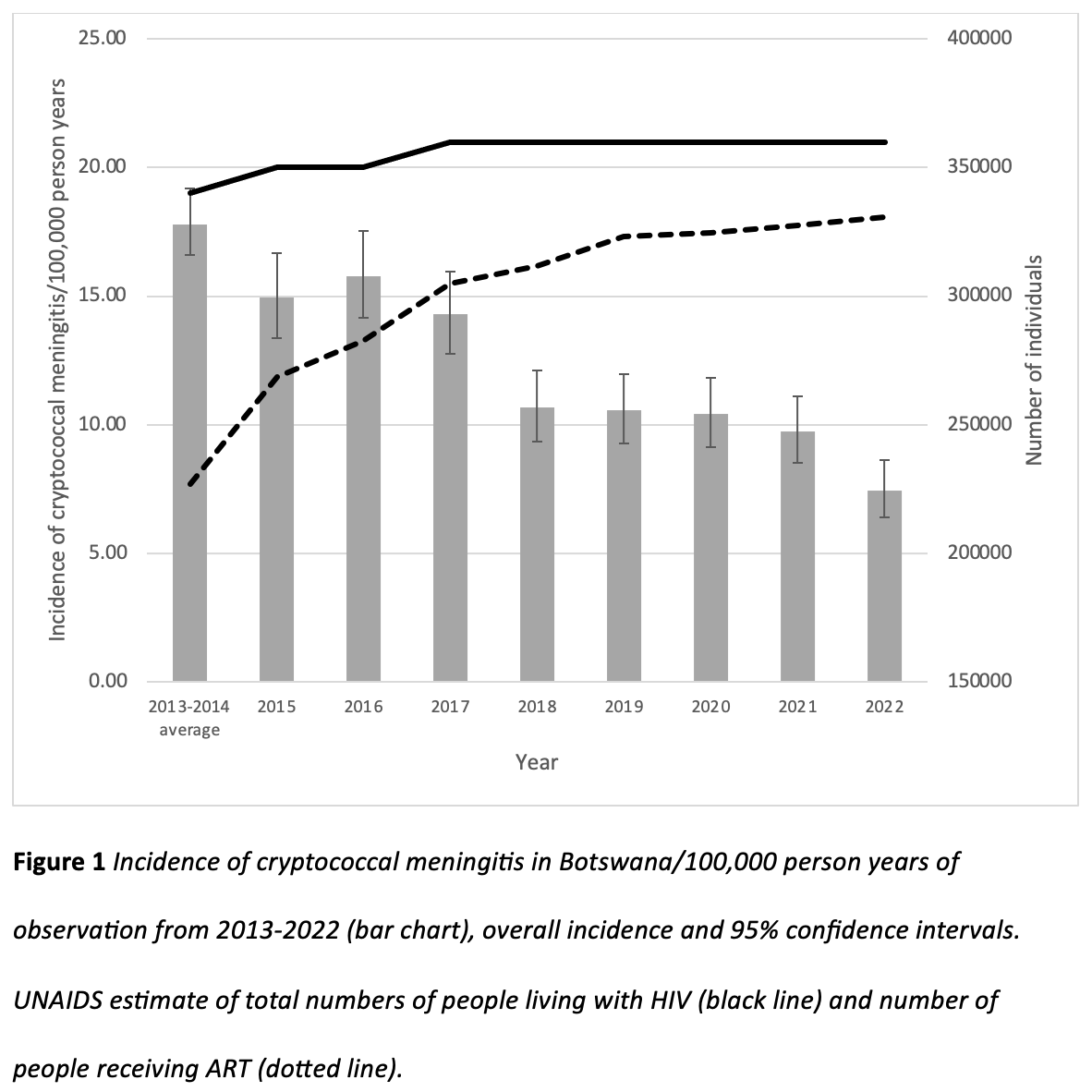
A total of 1,744 episodes of CM were identified. The estimated national incidence of CM in Botswana approximately halved between 2015 and 2022, from 15.0 cases/100,000 person years (PYO) (95% CI 13.5-16.7 cases/100,00) to 7.43 cases/100,000 PYO (95% CI 6.4-8.6 cases/100,000). Among all people living with HIV, the incidence of CM decreased from 92.0 cases/100,000 PYO (95% CI 82.2-102.6 cases/100,000 PYO) to 49.1 cases/100,000 PYO (95% CI 42.2-57.0 cases/100,000 PYO) between 2015 and 2022. There was no clear increase in the rate of decline following the introduction of universal treatment in 2016. The highest incidence was observed in men and individuals aged 40-44. The proportion of cases diagnosed through rapid cryptococcal antigen (CrAg) testing increased during the study period from 35.5% to 86.3%.
Conclusions:
CM incidence has decreased with expanded ART treatment but persists at a relatively high rate despite excellent reported ART coverage. Most cases are now diagnosed through the rapid CrAg lateral flow assay highlighting the potential of using CM as key indicator for programme success in the Treat All era