Background:
Vaccination before SARS-CoV-2 infection might confer partial protection against the development of post-COVID conditions (‘long COVID’) compared to unvaccinated individuals. However, evidence is limited in this regard. This study aims to systematically investigate the association between different vaccination status on a series of long COVID conditions by organ system.
Methods:
We identified COVID-19 positive adults between March 17, 2021 and January 15, 2022 from the statewide COVID-19 tester cohort. Setting the date of first positive SARS-CoV-2 as the index time (T0), we selected the individuals who were alive at least 30 days after T0. A total of 132 individual long COVID conditions were ascertained through ICD-10 codes from day 30 after T0 until a maximum of 180 days of follow-up. Individuals were classified as: partially vaccinated if they receive one dose of Pfizer-BioNTech or Moderna vaccines; fully vaccinated if they received either two doses of Pfizer-BioNTech or Moderna vaccines or a single dose of Janssen; and boosted vaccination if they receive the booster dose before T0. We employed Cox regression models to estimate the hazard ratio of the risks of individual sequelae by vaccination status, adjusting for relevant covariates. The incident symptoms or conditions that were significantly associated with vaccination status were grouped by organ systems.
Results:
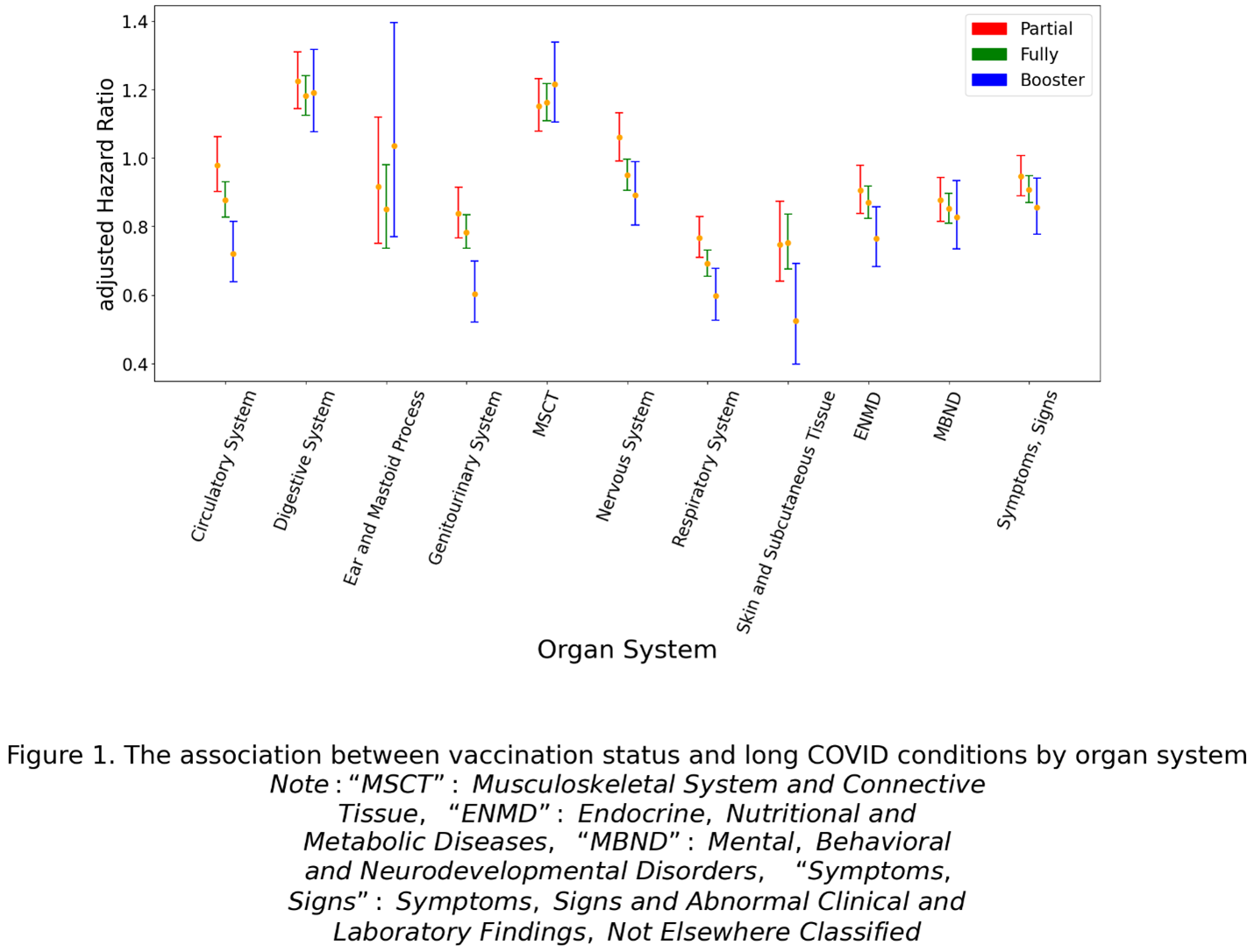
Among a total of 246,508 subjects, the prevalence of any long COVID conditions was 26.03%, with no major differences across the pandemic waves (e.g., Omicron). With a reference group of unvaccinated individuals, individuals with any dose of vaccination were associated with lower odds of 68 individual sequalae conditions, which involves 11 organ systems. Such protective effect was even higher among individuals who received booster dose. For example, a decreased risk of the disease of the Respiratory System was observed for individuals with fully (adjusted hazard ratio [aHR]: 0.75, 95%CI: 0.68, 0.84) and booster vaccination (aHR: 0.60, 95%CI: 0.53-0.68). Likewise, a reduced risk was also observed for the diseases of the Circulatory System (fully: aHR: 0.88, 95%CI: 0.83-0.93; booster: aHR:0.72, 95%CI: 0.64-0.81), Skin and Subcutaneous Tissue (fully: aHR:0.75, 95%CI: 0.68, 0.84; booster: aHR: 0.52, 95%CI: 0.40-0.69).
Conclusions:
In this statewide longitudinal observational study, we observed that fully or boosted vaccination appears to have some extent of protection against the development of multiple long COVID outcomes.