Background:
In the current era of universal antiretroviral treatment (ART), health systems have the dual challenge of a growing number of people living with HIV and on ART who are also receiving chronic, life-long treatment for non-communicable diseases. Current evidence suggests that multi-month dispensing (MMD) for HIV can maintain at least equivalent clinical outcomes to conventional care and reduce costs, but little evidence exists when integrating MMD for multiple conditions. We examined the cost-effectiveness of integrated MMD for people living with HIV and hypertension.
Methods:
Using an age and sex-specific hybrid decision tree and Markov state-transition model, we constructed a 100,000-person simulated population cohort who may develop HIV and hypertension and initiate treatment at clinics in South Africa over a 10-year time horizon. We assessed the incremental costs and effectiveness of MMD versus conventional care from a health system perspective under different conditions of care seeking, eligibility, and uptake of MMD for clinically stable patients. Model inputs were sourced from previously published literature. MMD was defined as reducing the frequency of clinic visits by increasing the number of medications dispensed to stable patients at each visit from 3 to 6 months. For the integrated MMD, we assumed that comorbid patients receive both HIV and hypertension drugs at the same facility on the same day.
Results:
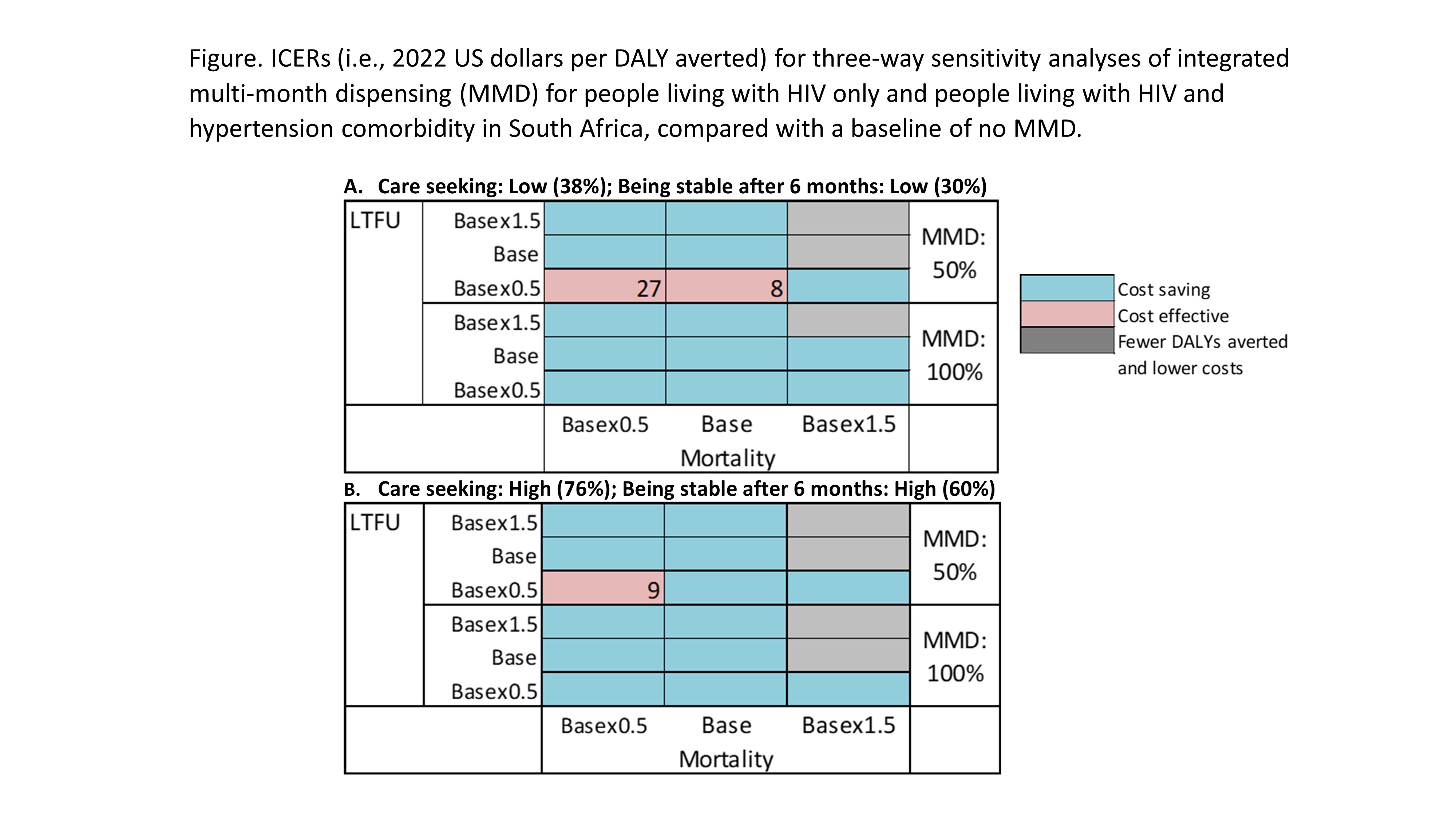
Our study demonstrates that integrated MMD for HIV and hypertension in South Africa can avert between 0.08 and 0.11 DALYs and save between $166 and $208 health systems costs per patient per year. Across all scenarios, HIV prevalence, care seeking level, mortality rate and LTFU rate were key drivers in DALYs averted; HIV prevalence, outpatient costs per visit and ART cost were key drivers in health systems cost. Overall, greater MMD integration, higher care seeking and a greater proportion of well-controlled patients in care led to greater cost savings or better (lower) ICER values.
Conclusions:
Integrated MMD is likely cost-saving (or highly cost-effective at ≤$30 per DALY averted) in various care-seeking scenarios and proportions of patients in care. Scale-up of MMD strategies is most effective when multiple conditions are addressed simultaneously. The benefit of integrated MMD may be greater than what we have estimated here through the potential for greater care-seeking and disease control among patients already in care with less LTFU and fewer deaths through high-quality care.