Background:
Virologic failure (VF) in patients on TLD often results from non-adherence given dolutegravir’s high resistance barrier. Real-time adherence measurement could improve counseling, help patients achieve virological suppression (VS), reduce viral load (VL) tests, and promote cost-effective (CE) adherence interventions. In Namibia, we found that a new point-of-care (POC) urine-based tenofovir (TFV) assay-based intervention increased VS to 90% among those with VF on TLD after 3 months of WHO-recommended enhanced adherence counseling (EAC). These results contrast with an overall 71% VS rate worldwide for those on ART as estimated by the UNAIDS July 2023 report.
Methods:
We modeled the health and cost impacts of two possible implementation scenarios with the urine assay over a year, comparing them to the standard of care (SoC) involving monthly EAC alone for VF, with VL tests every 3 months. Scenario 1 involved monthly TFV POC testing and EAC with a VL test after 3 consecutive positive POC tests; scenario 2 further restricted the use of VL testing to patients with no record of VS throughout the intervention period and an assumption that those who achieved VS remained adherent for a year. In 2020, the cost of VL and TFV POC testing was $63 and $1.33, respectively, for both SoC and the two scenarios. The cost of EAC ranged from $1.17 to $1.92 based on duration of session. Baseline ART adherence and VS data were obtained from the clinical study and UNAIDS. We assumed no patients would drop out of care.
Results:
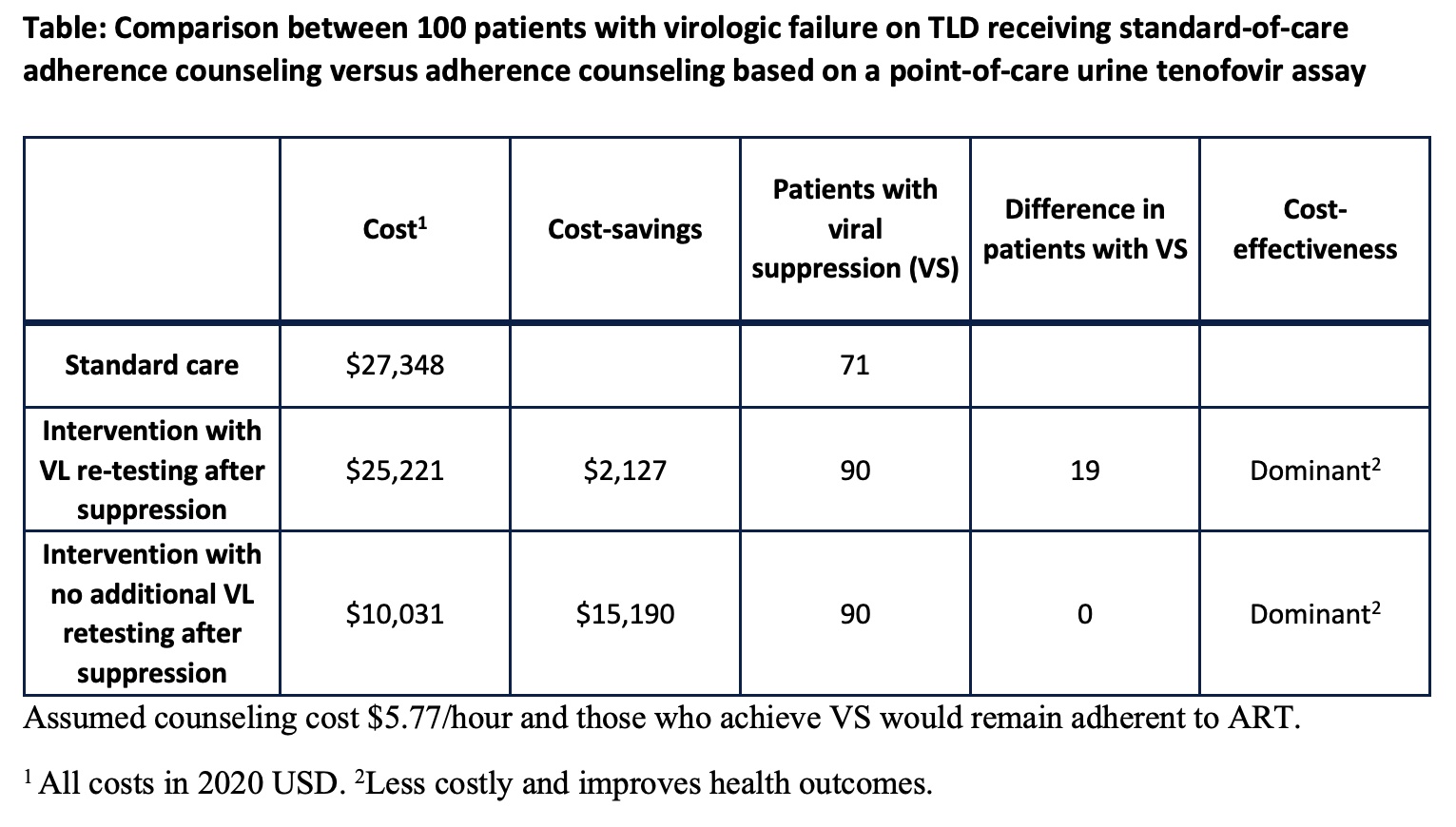
When following SoC guidelines, in a hypothetical cohort of 100 patients with VF on TLD, EAC alone increases VS to 71% at a total cost of $27,348. Scenario 1, in which POC tests were used to determine eligibility for VL tests, saved a total of 46 VL tests with a cost-savings of $2000, and resulted in 97% adherence and 90% VS. Scenario 2, where VL testing was not performed after VS was achieved, averted another 242 VL tests and an additional $15,190 (Table). It was assumed this large reduction in VL testing would not impact overall VS rates.
Conclusions:
The study evaluates the cost and cost-effectiveness of incorporating a POC urine TFV test into counseling for ongoing viremia on TLD; the intervention was less expensive and improved health compared to SoC. An upcoming clinical trial will compare SoC EAC to urine assay counseling in a large sample with further CE analysis with hopes of eventual wide implementation of the urine assay worldwide to reduce VF, viral resistance, and transmission.