There has been remarkable progress in the treatment of HIV throughout sub-Saharan Africa but data are limited on the prevalence and overlap of other significant causes of disease in HIV-endemic populations.
In a rural district of South Africa, we leveraged demographic and health surveillance infrastructure to estimate the population prevalence and geospatial distribution of HIV, active and lifetime tuberculosis, elevated blood glucose, elevated blood pressure and combinations of these. Adolescent and adult residents were offered multi-disease screening at mobile health camps near their homes. The health screening included WHO-STEP protocols for anthropomorphic and blood pressure measurements, HIV Ag-Ab enzyme immunoassay, HIV viral load and CD4 count, glycosylated hemoglobin (HbA1c) and TB screening (digital chest x-ray with automated image interpretation (CAD4TB), sputum Xpert MTB/RIF Ultra and liquid mycobacterial culture).
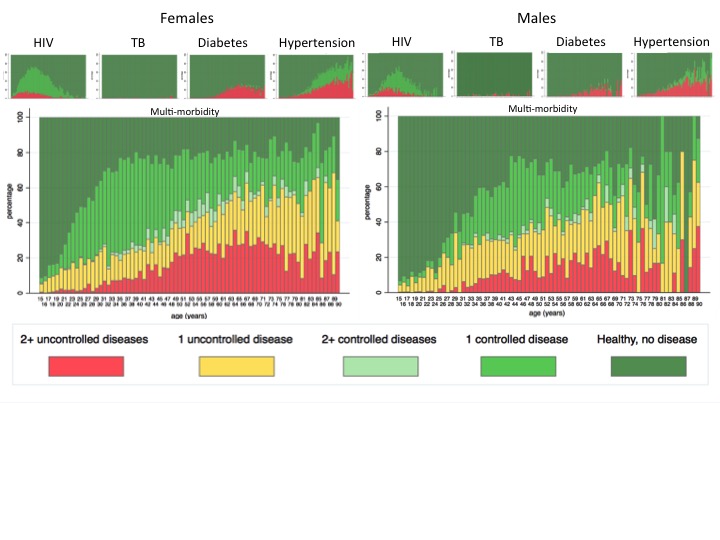
17,118 adolescents and adults were assessed. Overall, 52.1% (95%CI 51.3-52.9) had at least one active disease: 34.2% (95%CI 33.5-34.9) had HIV, 1.4% (95%CI 1.2-1.6) had active tuberculosis, 21.8% (95%CI 21.2-22.4) had lifetime tuberculosis, 8.5% (95%CI 8.1-8.9) had elevated blood glucose and 23.0% (95%CI 22.4-23.6) had elevated blood pressure. Appropriate treatment and control of disease was highest for HIV (76.3%), and lower for elevated blood pressure (40.0%), active tuberculosis (31.3%) and elevated blood glucose (6.9%). Disease prevalence differed significantly by sex, across age groups and geospatially: men had higher prevalence of active and lifetime tuberculosis, while women had extremely high prevalence of HIV in middle age and increasing prevalence of multiple and poorly controlled non-communicable diseases after the age of 50 years.
We found a convergence of infectious and non-communicable disease epidemics in a rural South African population, with HIV relatively well treated, but tuberculosis, elevated blood glucose and elevated blood pressure poorly diagnosed and treated. A public health response that expands the successes of HIV testing and treatment programme to provide multi-disease differentiated care targeted to specific populations is required to optimize health in such settings in sub-Saharan Africa.