Background:
Telomere length (TL) shortens with biological age, and decreased TL is associated with disorders such as cardiovascular disease, stroke, and diabetes. For people living with HIV-1 (PWH) without treatment, TL shortening is seen, and has been associated with immune activation and lower immunological response. ARVs and regimen received can impact TL; tenofovir has been shown to inhibit telomerase activity in vitro, and in clinical studies may be associated with shorter TL. The SALSA study showed switching to DTG/3TC fixed-dose combination (FDC) was non-inferior to continuing current antiretroviral regimen (CAR) at Week 48 (respectively, 94% vs 93% with viral load (VL) < 50c/mL) by Snapshot analysis. This post-hoc analysis assesses TL from baseline (BL) through 48 weeks.
Methods:
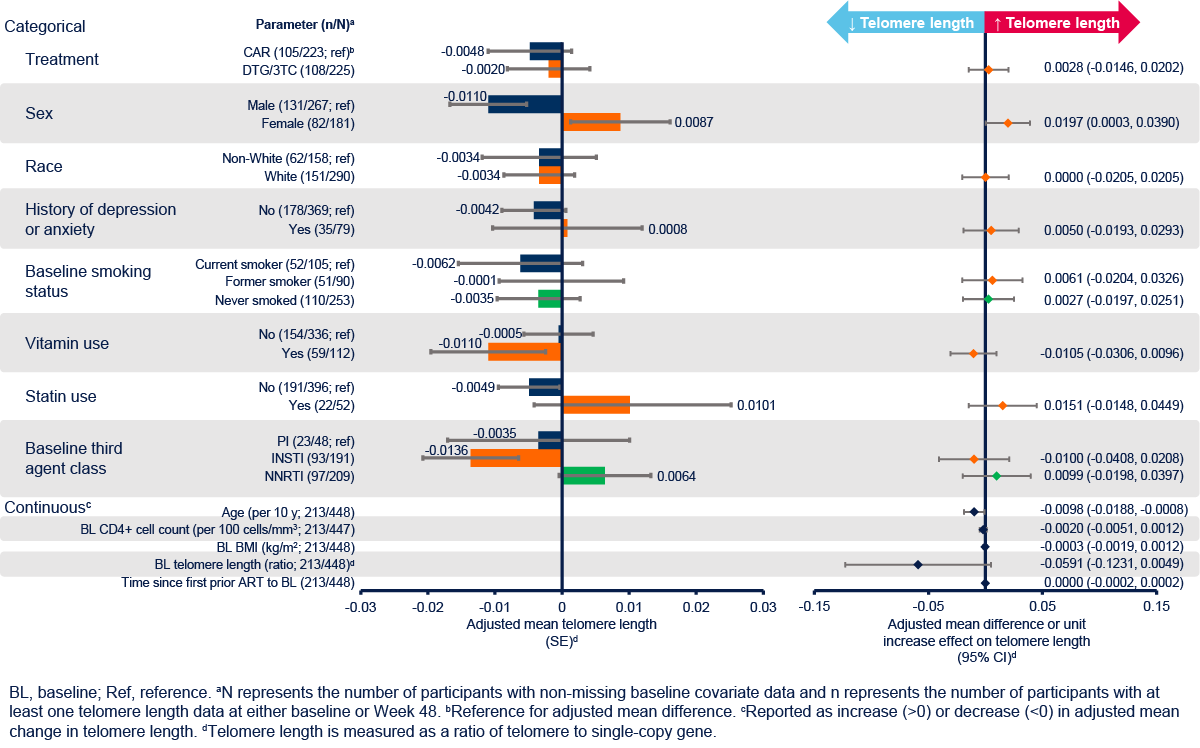
Adults with VL < 50c/mL for ≥6 months were randomized to DTG/3TC FDC or continued CAR with 81% (200/247) receiving TAF or TDF. qPCR using genomic DNA extracted from whole blood samples was performed to generate ratios of telomere TTAGGG repeats to a single-copy gene (T/S ratios) reflecting average TL of the total cell population. The adjusted mean difference in TL at Week 48 between treatment groups (DTG/3TC vs CAR) was calculated using an ANCOVA model including the following pre-specified covariates (Figure 1): CD4+ cell count, age, sex, race group, depression or anxiety, BMI, smoking status, vitamin use, statin use, BL TL, time since first prior ART, and BL third agent class (PI, INSTI, or NNRTI).
Results:
Adjusted mean changes from baseline in T/S ratio in the DTG/3TC and CAR groups were similar, −0.0020 vs −0.0048, respectively (treatment difference, 0.0028; 95% CI, −0.0146, 0.0202; P=0.751). Baseline factors associated with TL included age and sex (women had longer TL) as summarized in Figure 1.
Conclusions:
In the SALSA study, we show that age and sex significantly influenced TL as expected, however continuing TDF or TAF in the CAR arm did not appear to have an impact, though limitations include that 19% of participants in CAR arm did not receive a tenofovir prodrug. Of note, there was no impact on TL when switching to DTG/3TC over 48 weeks. This data, alongside non-inferior efficacy and minimal impact across inflammatory markers seen with DTG/3TC, challenges the value of the 2nd NRTI in a virologically suppressed switch population.
Figure 1. Forest plot view of telomere length change from baseline at Week 48 by covariate groups.