Differentiated service delivery (DSD) models provide flexibility for patients accessing antiretroviral treatment (ART) in sub-Saharan Africa, and decongest health facilities. With the global COVID-19 pandemic, DSD models, which promote social distancing and facilitate easier access to ART in the community are critical. We investigated the clinical effectiveness of community-based multimonth ART provision in high HIV prevalence settings in Zimbabwe and Lesotho.
Individual-level patient data were pooled from two cluster-randomized noninferiority trials that compared 3 and 6-monthly community-based ART provision vs. standard of care facility-based ART dispensing for stable HIV patients, which were conducted between 2017–2019. Both trials had three-arms: ART collected 3-monthly at facilities (3MF, control); ART provided 3-monthly in community ART refill groups (CARGs) (3MC); and ART provided 6-monthly in either CARGs or at community-distribution points (6MC). Stable adults with viral suppression receiving ART ?6 months were recruited. The primary outcome was retention in ART care 12 months after enrolment, and secondary outcomes were viral suppression and number of unscheduled clinic visits between months 0–12. Individual-level regression analyses were conducted by intention-to-treat specifying for clustering and adjusted for country.
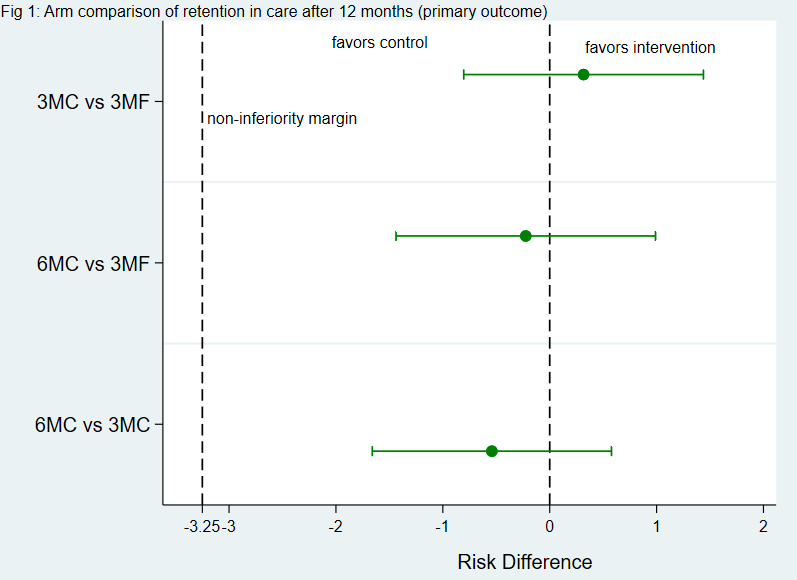
60 randomized clusters were included with 3817, 2893 and 3426 participants enrolled in arms 3MF, 3MC and 6MC, respectively. After 12 months, retention in 3MF, 3MC and 6MC was 95.0%, 95.7% and 95.1%, respectively; adjusted risk differences 0.3 (95% CI: -0.8 to 1.4); -0.2 (95% CI: -1.4 to 1.0) and -0.5 (95% CI: -1.7 to 0.6) for 3MC vs. 3MF, 6MC vs 3MF, and 6MC vs 3MC, respectively (Figure 1). All comparisons achieved the prespecified non-inferiority margin of -3.25%. Viral suppression after 12 months was high in all arms; 97.8%, 98.6% and 97.9% in 3MF, 3MC and 6MC, respectively, adjusted risk ratios=1.0 (95% CI: 0.99–1.01); 1.0 (0.97–1.01) and 1.0 (0.97–1.01) for 3MC vs. 3MF, 6MC vs 3MF, and 6MC vs 3MC, respectively. No differences in the number of unscheduled clinic visits between arms were apparent.
Community-based ART provision at both 3 and 6-monthly intervals were noninferior vs. 3-monthly facility-based dispensing in high HIV-prevalence settings for stable HIV patients. These DSD models are now more critical than ever, and can be scaled-up to promote social distancing and clinic decongestion to mitigate the impact of COVID-19.