Background:
Financial cost, societal stigma, and suboptimal community engagement delayed the scale-up of Pre-Exposure Prophylaxis (PrEP) among key populations in China. To overcome these barriers, we developed a CBO-clinic hybrid model to deliver PrEP.
Methods:
The PrEP demonstration project was carried out in two cities (Guangzhou and Wuhan) to provide free PrEP, guided by Community-based participatory research, in which researchers and community stakeholders engage as equal partners. In our model, social workers from community-based organizations (CBO) lead the social media-based recruitment and implementation of the project, such as developing the promotion strategies on the WeChat app or public account, liaising with potential participants, conducting pre-screening, and referring the participants to the clinic for lab testing, while healthcare providers lead the PrEP prescription and monitoring. After enrollment, social workers offered both picking-up or mail delivery of PrEP to participants to make the services more convenient. Baseline demographic data and the results of our CBPR strategies were summarized.
Results:
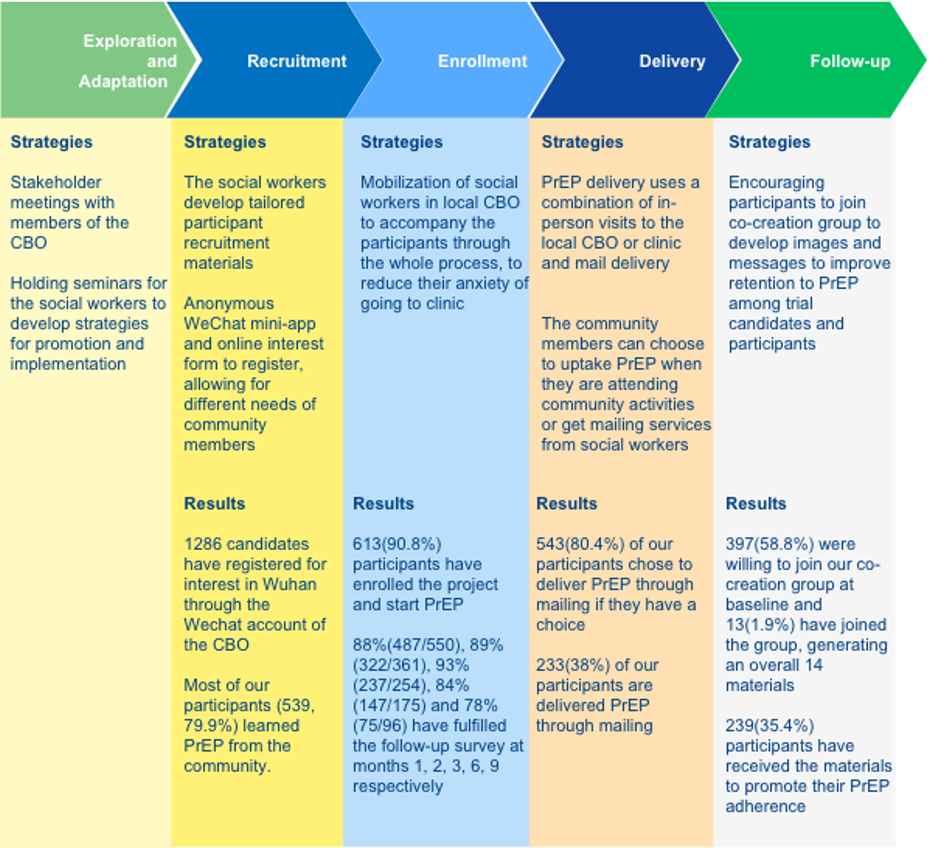
From September 2021 to September 2022, PrEP and STI self-testing services were delivered to 675 participants, 391(58%) in Guangzhou and 284(42%) in Wuhan. Overall, 656 (97.2%) of the participants were cisgender men. 653(96.8%) self-identified as MSM (93.5% MSM and 3.3% MSMW). The median age was 28.8. In the 3 months follow-up survey, among those who reported their regimen, 21% (55/260) of participants reported on-demand regimen. The fully-adherent (self-reported taking 6-7 pills per week on daily regimen) rates were 97% (200/205), 96% (120/125), and 97.2% (35/36) at months 3, 6, 9 respectively.The results of our CBPR strategies suggest that 1286 candidates have registered for interest through CBO’s public account, most of our participants (539, 79.9%) learned PrEP from the community, 613(90.8%) participants started PrEP after enrollment, and 233(38%) participants are delivered PrEP by mailing. The detailed strategies and statistics are shown in Figure 1.
Conclusions:
Findings from our demonstration project suggest that MSM in China are likely to be incentivized by the community. A hybrid CBO and clinic-based model is an effective way to deliver PrEP, as in-person visit provides professional advice, and mailing promotes the accessibility of PrEP. The mobilization of local CBO that closely works with the community can engage the community by developing people-centered services.
Figure 1. Our community engagement strategies and results