The ongoing SARS-CoV-2 pandemic poses an urgent need to identify novel drug treatments that are effective, well tolerated and quickly translatable to a clinical setting.
In-silico binding modes were predicted by molecular docking. The Bavpat1/2020 SARS-CoV-2 isolate was used to infect Calu-3, T84, Vero E6 cells and a primary colon organoid at MOIs of 0.05 or 0.5. Supernatant and intracellular SARS-CoV-2 RNA was quantified by RT-qPCR or immunofluorescence (IF). The activity of the main protease of SARS-CoV-2 (3CLpro) was measured by FRET assay. Viral protein expression was assessed by western blot. Syncytia formation was determined by IF in cells expressing the spike protein. Cell viability was determined by MTT and crystal violet staining. Synergism scores were calculated using the SynergyFinder web-tool.
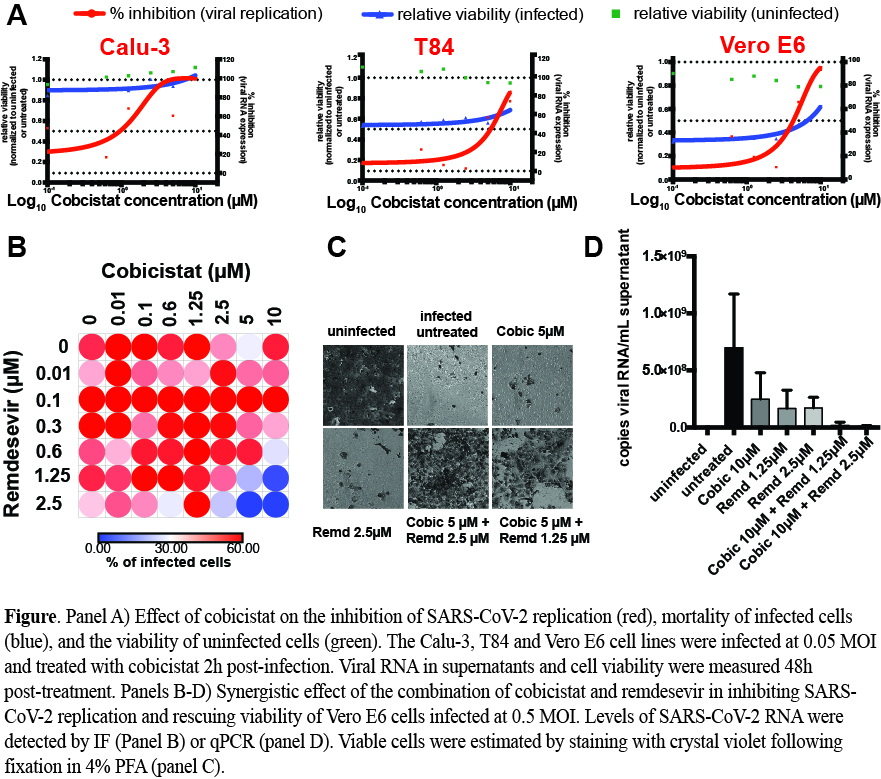
In-silico docking using a library of FDA-approved drugs highlighted cobicistat as candidate inhibitor of SARS-CoV-2 3CLPro. Experiments using two different viral MOIs in three different cell lines proved that cobicistat inhibits SARS-CoV-2 replication at non-toxic, low micromolar concentrations (IC50 0.6-9µM; CC50 39-52 µM) (Fig 1A). However, cobicistat did not inhibit 3CLpro activity in FRET assay, while western blot analysis suggested that cobicistat impacts on spike glycoprotein levels/processing. Accordingly, cobicistat decreased syncytia formation in spike-expressing Vero E6 cells. The range of in-vitro antiviral concentrations of cobicistat was compatible with plasma levels reachable in mice and humans, but above those achieved through standard dosages used to boost HIV-1 protease inhibitors, in line with the failure of trials testing cobicistat-boosted darunavir on SARS-CoV-2 patients. As the booster activity of cobicistat is exerted through inhibition of Cytochrome P4503A (CYP3A) and P-glycoprotein P-gp (known also as multidrug resistance MDR1), we combined it with remdesivir, which is a putative CYP3A and P-gp substrate. The drug combination was able to synergistically rescue the viability of infected cells to levels comparable to uninfected controls and to almost entirely abrogate viral replication in two cell lines and a primary colon organoid (Figure 1B-D).
Cobicistat and remdesivir synergistically inhibit SARS-CoV-2 replication and cytopathic effects. Cobicistat can form the backbone of combination treatments due to its dual activity as direct antiviral and pharmacoenhancer.