Background:
Youth living with HIV (YLWH) have disproportionately poor virological outcomes. We hypothesized that a community-based intervention incorporating the whole HIV cascade (testing, treatment, adherence support) integrated with sexual & reproductive health (SRH) services, would improve HIV outcomes among youth. Integrating SRH may increase engagement in a hard-to-reach group with limited access to health services.
Methods:
A cluster randomized trial (CHIEDZA) was conducted across 3 provinces in Zimbabwe, each randomized 4:4 to control (existing services) or to intervention clusters (total 24 clusters). A cluster was a geographically demarcated area with a community center, from where weekly integrated HIV & SRH services were delivered to intervention cluster residents aged 16-24 years. The primary outcome was virological suppression (VS) ( < 1000copies/ml) among YLWH after 30 months, ascertained through a population-based survey of 700 18-24 year olds/cluster (total 16,800). Secondary outcomes assessed each step of the HIV cascade.
Results:
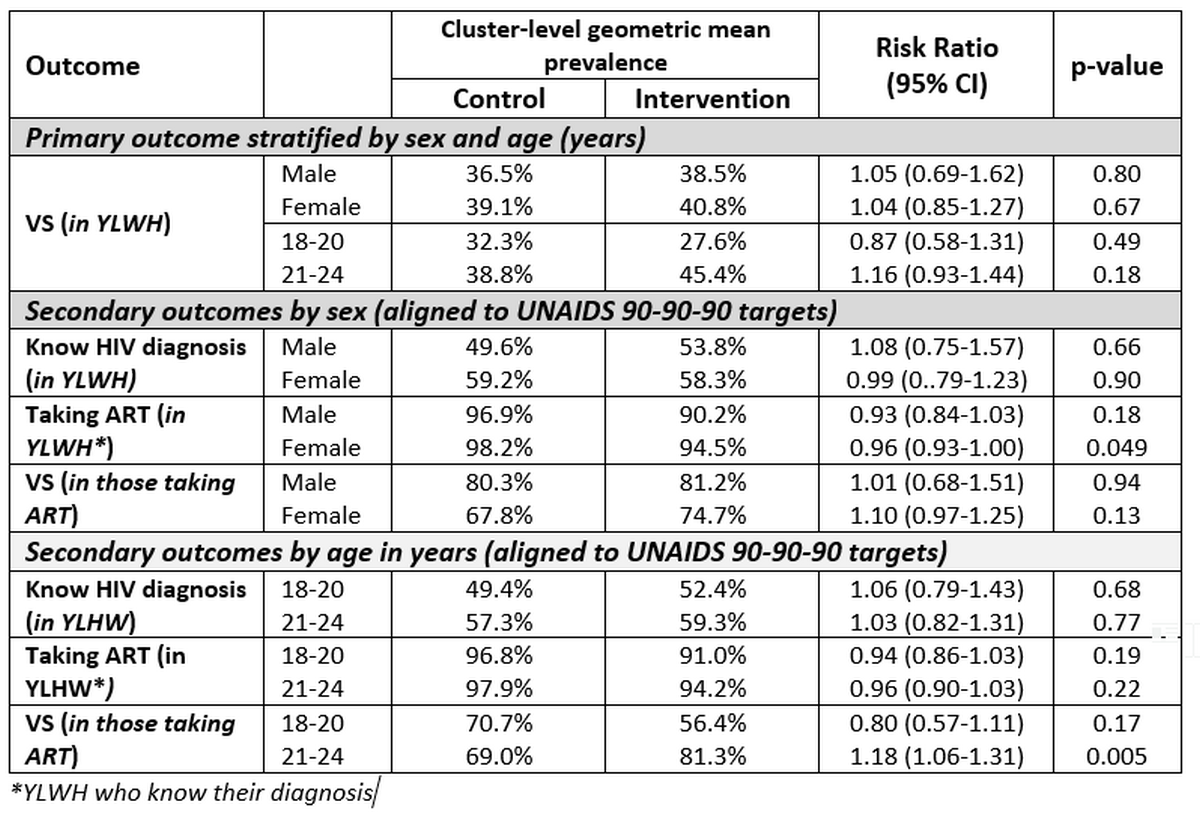
36,991 youths accessed the CHIEDZA intervention (estimated 95% of eligible population in intervention clusters), of whom 84% had ≥1 HIV test. Of the 1539 YLWH CHIEDZA intervention attendees (24% newly diagnosed), 1445 (94%) were linked to HIV care of whom 1409 (97%) were taking ART; of 815 on whom VL was available, 80% had VS. The population-based survey enrolled 17682 (95% of those eligible), 60.7% female; 47.7% aged 21-24 years. In the intervention arm, 29% reported accessing CHIEDZA. HIV prevalence was 5.9% and 7.5% in intervention and control arms respectively. A higher proportion in the intervention than control arm reported having an HIV test (71.1% vs 66.1%, p=0.016) and knowledge of HIV status (68.5% vs 63.1%, p=0.057). There was no difference by arm in the primary outcome (40% vs 37.8%, RR 1.05 (95% CI 0.86-1.28), or in secondary outcomes. Among older YLWH taking ART, VS was higher in the intervention than the control arm (interaction p=0.017) (Table 1).
Conclusions:
Despite high levels of HIV testing and treatment achieved by CHIEDZA, there was no population level impact on VS. While the intervention did increase knowledge of HIV status among youth at population level, those at highest HIV risk were not identified, which likely explains lack of intervention effect. Mobility explains the 29% reported coverage at endline (despite 95% eligible population served). Nearly 50% of YLWH remain undiagnosed; strategies to address this are urgently needed.
Table 1: Primary and secondary outcomes stratified by age and sex