Background:
Mpox is a pivotal example of how old viral pathogens can emerge as the cause of new outbreaks with novel clinical presentation and topical route of transmission. Here we present an analysis to explore potential predictors of Mpox severity and viral persistence in relevant biological fluids.
Methods:
Italian multicenter cohort study. Severe cases were those who needed hospitalization or had proctitis, pharyngotonsillitis, ocular lesions, or >20 skin lesions. Recovery was defined as the resolution of all mucocutaneous lesions. Bivariable analysis of severity predictors was carried out with X2 test. Logistic regression model was used for multivariate analysis. The analysis to assess early viral load (VL) as predictor of severity was done by Student T-Test and logistic regression model.
Results:
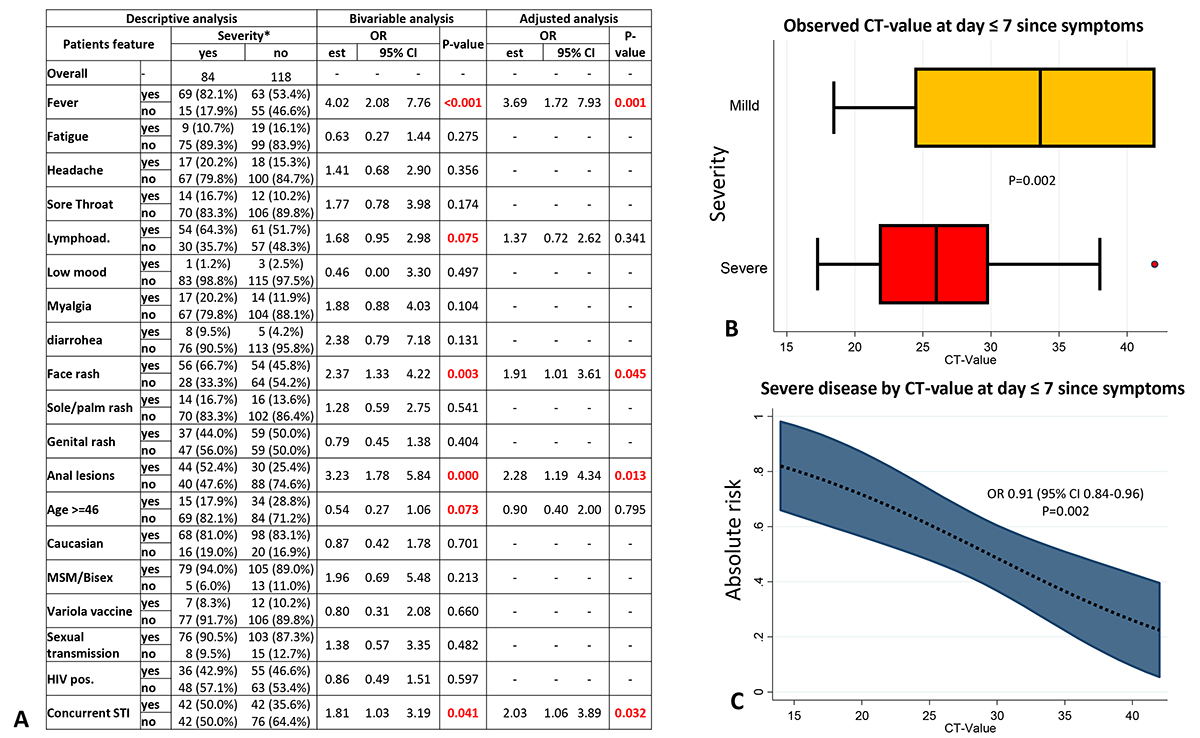
Between 16 May and 31 Oct 2022, 202 pts were enrolled; they were all male with a mean age of 38 years (range 21-75). Mean duration of disease was 22.14 days (95%CI 20.93-23.34). Multivariable analysis to explore severity predictors (Fig1A) showed that fever (p=0.001), facial lesions (p= 0.045), anal lesions (P=0.013), and concurrent STIs (P=0.032) were associated with severe Mpox. Quantitative determination of VL load in the upper respiratory tract (oropharyngeal swab or saliva, URT) was available for 79 pts (39 mild and 40 severe). Mean Ct-value was 31.91 (95%CI 29.29-34.54) and 26.68 (95%CI 24.68-28.68) in mild and severe cases, respectively (P < 0.002; Fig1B). Logistic model showed that probability to develop severe disease had a strong inverse association with Ct-value dropping by 9.38% (95%CI 3.21-15.16%) per Ct-value unit (P=0.002; Fig1C B). We found no association between severity and VL in specimen from skin lesions, urine, blood, and anorectal region. Finally, we found that MPXV persists in body fluids despite clinical recovery: detectable amount of MPXV was found in sperm (12/28 pts), urine (3/50), anorectal (6/31), and URT (17/51) specimens.
Conclusions:
We found that pts presenting with fever, facial/anal lesions, and concurrent STIs may develop more severe Mpox. Moreover, higher VL in URT during the first week after symptoms onset was associated with severe disease. Our findings may serve to guide management of pts with Mpox in terms of need for hospitalization and drug therapy. Finally, our study claims an urgent need to assess whether the persistence of MPXV in biological samples after clinical recovery may lead to a status of persistent infectivity.
Figure legend. A) Analysis of risk for severe disease (Nf202 patients). Left columns descriptive analysis. Middle columns bivariable analysis of risk (p-values are reported according to X2 test). Right columns adjusted analysis according to multivariable logistic model (P-values are reported according to Wald’s test). B) Observed CT-value in upper respiratory tract during the first week of disease (Nf79 patients; P-values are reported according to Student T-test). C) Association between severe disease and CT-values in the upper respiratory tract during the first week of disease (Nf79 patients; P-values are reported according to Student Walds’s test). OR= odd-ratio, STI= sexually transmitted infection, 95%CI= 95% confidence interval.