Background:
The heterogeneity of risk for invasive anal cancer (IAC) among individuals living with HIV (PWH) underscores the importance of identifying clinical predictors to inform a shared decision-making framework for screening. We investigated predictors of IAC and described outcomes among those diagnosed with IAC.
Methods:
The study clinic assembled a longitudinal HIV inception cohort of anal cancer screening outcomes. Screening procedures included anal cytology, digital anorectal examination, high-resolution anoscopy (HRA), and access to ablative treatments. We computed the adjusted probabilities of developing IAC over 5 and 10 years since the initial screening anal cytology. We describe the clinical outcomes of those diagnosed with IAC. Cox proportional models with inverse probability weighting were fit to account for differential screening in the cohort and to construct a nomogram for predicting IAC risk.
Results:
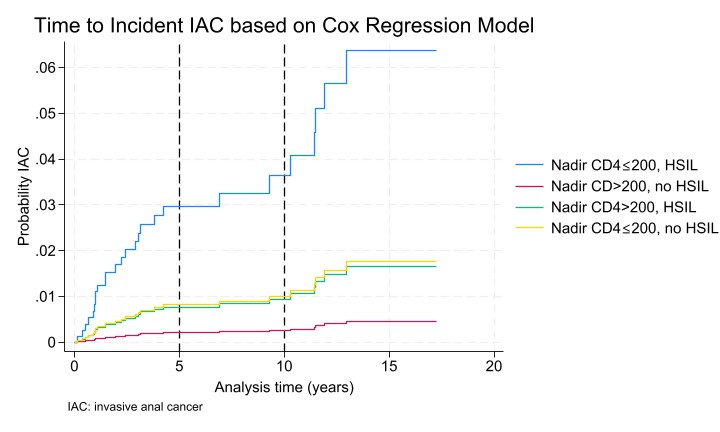
Between 2007 to 2020, 8139 PWH received care at UCSD Owen Clinic, of whom 4105 (49.8%) underwent at least 1 anal cytology test and were followed for a median of 5.5 years (up to 13 years). Among them, 32 individuals develop IAC (age range at diagnosis 29-76 years). Those diagnosed with IAC following their first anal cytology were more likely to be younger and exhibit anal high-grade squamous intraepithelial lesion (aHSIL) on initial or subsequent follow-up cytology. Additionally, they showed lower median and nadir CD4 cell counts and underwent anal ablative treatment less frequently. Analyses did not reveal differences in IAC development based on gender identity, race, ethnicity, HIV risk factor, or tobacco use. The highest risk of IAC was associated with PWH having nadir CD4 cell count less than 200 with a hazard ratio (HR) of 3.73 (95%CI 1.61-8.54) and cytology aHSIL (HR 3.75 1.47-9.47). PWH with a combined nadir CD4 cell count of less than 200 and cytology aHSIL will have a 5- and 10-year probability of IAC of 2.9% and 3.7%, respectively (Figure). Of 32 PWH diagnosed with IAC, 7 died due to cancer progression. All who died due to IAC had clinical stages IIIA or higher, and of them, 3 had declined to have an HRA ever, and 1 opted out of recommended HRA surveillance.
Conclusions:
PWH with nadir CD4 cell count below 200 and cytology aHSIL have the highest risk of anal cancer within 5 years of follow-up. All patients who died had anal cancer clinical stages IIIA or higher at diagnosis, highlighting the importance of early diagnosis through HRA cancer surveillance.