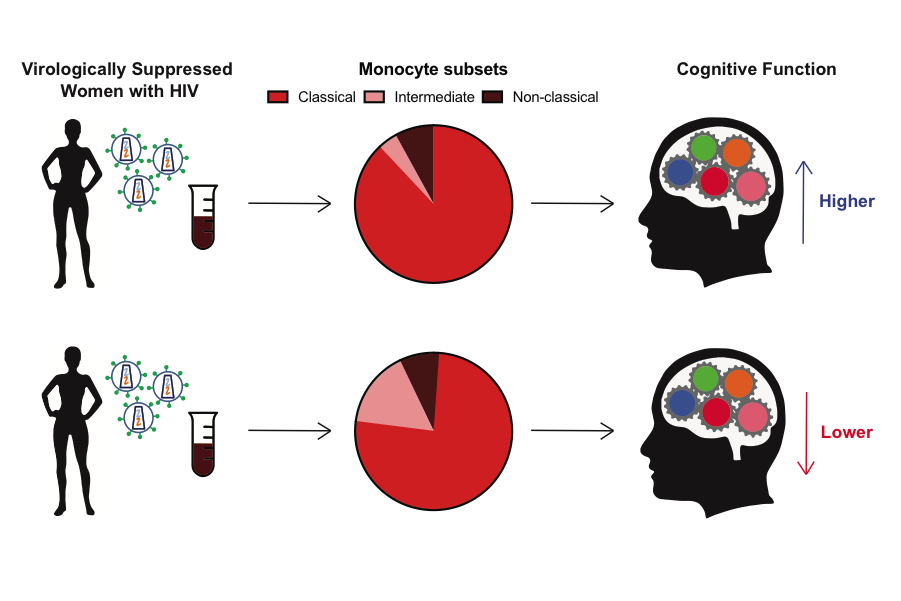
Identifying a quantitative biomarker of neuropsychiatric dysfunction in people with HIV (PWH) remains a significant challenge in the neuroHIV field. The strongest evidence implicates the role of monocytes in central nervous system (CNS) dysfunction in HIV. Studies have assessed monocyte subsets combined with other markers (CCR2, sCD163, sCD14, HIV DNA). However, no study has examined the proportion of monocyte subsets in blood as a correlate and/or predictor of neuropsychiatric function in PWH in the era of modern antiretrovirals.
In two independent cohorts of virologically suppressed women with HIV (WWH; n=19 and n=18), whole blood samples were obtained either in conjunction with neuropsychiatric assessments (neuropsychological [NP] battery, depression and stress-related symptom questionnaires) or one year prior to the clinical assessments. Immune cell proportions were assessed in whole blood or freshly isolated PBMCS by flow cytometry. To examine associations between total monocytes, monocyte subsets, T-cell populations, and neuropsychiatric outcomes, we conducted Spearman’s Rho correlations (rs). Adjusted analyses were not required as none of our measured variables (age, CD4 count) met the definition of being a confounder.
A higher proportion of intermediate (CD14++CD16+) monocytes was associated with lower global NP function when assessing monocytes concurrently (rs=-0.60, P=0.006) and approximately one year before (predictive) NP testing (rs=-0.54, P=0.02). The same pattern was seen for mental flexibility (concurrent: rs=-0.53, P=0.01; predictive: rs=-0.68, P=0.003) and processing speed (concurrent: rs=-0.58, P=0.009; predictive: rs=-0.65, P=0.003). Conversely, there were no associations with monocyte subsets and mental health symptoms. However, lower CD4 T cell proportions were associated with higher perceived stress (rs= -0.58, P=0.03). A higher proportion of classical monocytes was also associated with better cognition (rs= 0.48-0.67, P’s<0.05).
It is widely accepted that lentiviral infection of the CNS targets cells of monocyte-macrophage-microglial lineage and is associated with an increase in intermediate monocytes in the blood and monocyte migration into brain. However, the proportion of intermediate monocytes in blood of virally suppressed WWH has never been directly associated with cognition. Our findings provide initial evidence for a new, easily measured blood-based cognitive biomarker in WWH.