Background:
New HIV infections have declined substantially in eastern Africa with the introduction of combination HIV interventions (CHI). However, it is unknown whether incidence has declined throughout the population or whether ongoing transmission is driven by sub-populations with high HIV incidence.
Methods:
We used a machine learning algorithm applied to 12 survey rounds of data (1999-2016) from the Rakai Community Cohort Study (RCCS) in Uganda to identify population sub-groups with similar demographic and sexual behavioral characteristics. Sub-groups (i.e., clusters) were identified using k-means clustering agnostic to HIV status, with the number of clusters selected to optimize parsimonious prediction of HIV status. We assessed changes in cluster size, proportion of incident HIV cases accounted for, and within-cluster HIV incidence rates (IR) over time. Our algorithm supported 3- and 36-cluster solutions, depending on the fit statistic used (BIC vs. AIC). HIV incidence rate ratios (IRR) and 95% confidence intervals were calculated by visit and CHI epoch (pre CHI: 1999–2004; early CHI: 2005–2011; late CHI: 2011–2016) for each cluster. In the 3 cluster solution, we categorized clusters as low (0.38/100 person years [pys]), average (0.79/100 pys), and high (1.5/100 pys) risk based on pre-CHI HIV IRs.
Results:
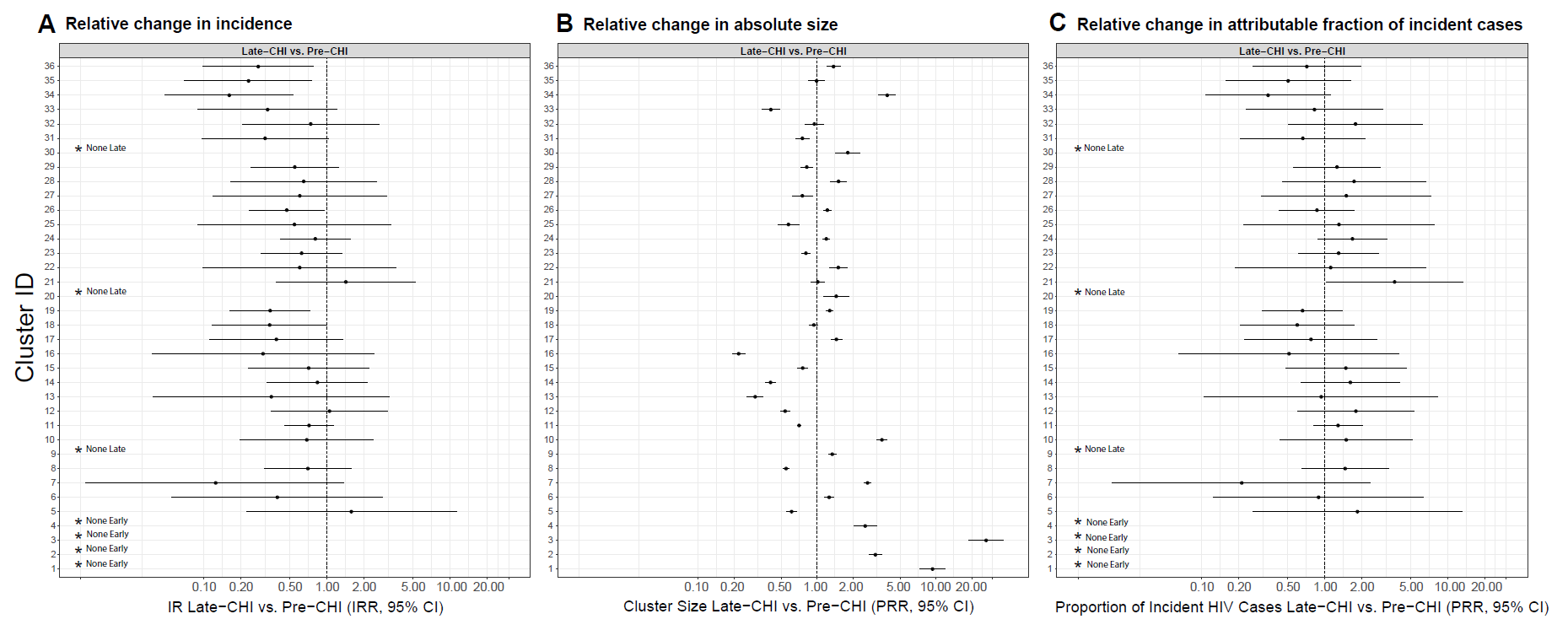
33,866 individuals contributed 102,759 person-visits to the analysis. Most clusters with low pre-CHI incidence increased in size while the size of average and high-risk clusters decreased or remained unchanged. In the 3-cluster solution, the low-risk cluster increased from 8.7% of participants in 1999 to 20.0% by 2016, while the average-risk and high-risk clusters decreased in size from 50.9% to 45.5% and 40.3% to 34.5% respectively. IR per 100 py trended downwards in low and medium risk clusters, while significantly declining in the high-risk cluster (IRR 0.50, 0.29-0.86). In the 36-cluster solution, HIV IR declined in most clusters (Figure). The majority of incidence reduction (89%) could be attributed to within-cluster risk reductions, rather than changes in cluster size. Incidence did not concentrate among clusters with higher pre-CHI incidence over time.
Conclusions:
In southern Uganda, HIV incidence has declined in nearly all population sub-groups with few exceptions and with no concentration of incidence in high-risk groups. More targeted strategies may be needed to reduce HIV risk in population sub-groups where incidence has remained stable or increased.
Changes in cluster incidence rate, size, and attributable fraction of incident HIV cases over time (36-Cluster Solution). Asterisks indicate clusters where there were zero incident cases in either the early or late-CHI period. Clusters are numbered in ascending order based on pre-CHI incidence levels (e.g., cluster 1 had the lowest pre-CHI incidence and cluster 36 the highest).