Background:
The spread of the mpox virus in 2022 primarily within the sexual networks of men who have sex with men (MSM) triggered a potentially stigmatizing public health response in the US. Despite mpox primarily spreading through skin-to-skin contact, most messaging has promoted abstinence and/or reduction in sexual risk behaviors. Persistent risk reduction may be necessary to prevent future surges; therefore, ongoing work is needed to investigate whether decreases in sexual risk behaviors continue among sexual and gender minority (SGM) youth and young adults (YYA), and what factors are associated with persistence of risk reduction behaviors.
Methods:
The parent study, Keeping it LITE, examined HIV risk factors in young adults who reported sexual activity between 2017 and 2019 (n=3,444). A substudy of mpox was conducted between September 10th and 20th, 2022 for all active participants with Illinois residency (n = 469). Survey questions included demographic data and sexual risk reduction behaviors. Responses were aggregated, and an exploratory factor analysis (EFA) was utilized to investigate potential behavioral clustering using MPlus. Bivariate analyses were conducted with three outcome variables related to sexual risk-taking. Odds ratios (ORs) and 95% confidence intervals (CIs) were calculated for the dichotomous outcome of reporting sexual contact since June 1st. Generalized linear models (GLMs) with corresponding F-statistics were generated for both sexual risk reduction factors.
Results:
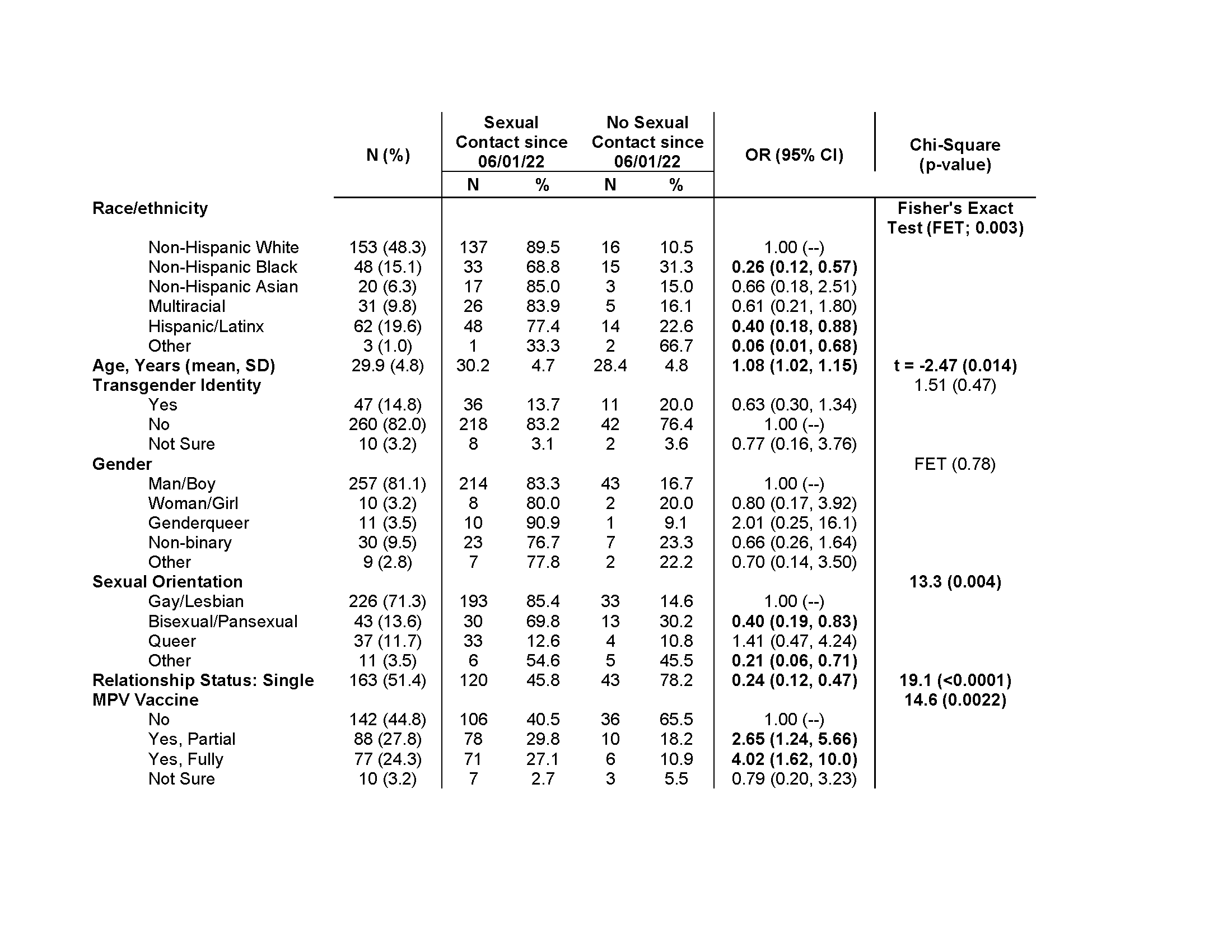
Survey participation was 68.2% (322/469). Three-quarters of participants (82.6%) reported sexual activity since June 1st. Most sexually active participants (83.5%) reported adopting at least one sexual risk reduction behavior because of mpox. Black and Hispanic/Latinx participants were less likely to be sexually active, but more likely to report risk reduction behaviors (31.3% and 22.6%, respectively). Participants who received the mpox vaccine were more likely to report sexual activity.
Conclusions:
SGM YYA in Illinois overwhelmingly reported reducing sexual contact due to the mpox outbreak. Vaccinated individuals were more likely to report sexual activity and a greater number of prophylactic activities. Thus, sex-positive and harm reduction messaging strategies are likely to be more effective than abstinence-only prevention, which may further stigmatize marginalized groups.
Demographic Characteristics and Bivariate Associations with Sexual Contact (n = 317).