Background:
HIV preexposure prophylaxis (PrEP) is effective at preventing infection among persons at risk for acquiring HIV. PrEP campaigns have focused on sexual behaviors, particularly same-sex behaviors, and may not be reaching heterosexual-identifying men or people who inject drugs. This analysis aimed to explore changes in PrEP awareness and use among men who have sex with men and inject drugs (MSM-ID) in 2018 and 2022 by sexual orientation.
Methods:
We analyzed data from 2018 and 2022 National HIV Behavioral Surveillance among people who inject drugs recruited via respondent-driven sampling in 19 US urban areas. The analytic sample was restricted to HIV-negative males who inject drugs and who had sex with another man in the past 12 months (MSM-ID). Using log-linked Poisson regression models, adjusted prevalence ratios (aPRs) and 95% confidence intervals (95% CIs) were calculated to estimate changes in PrEP awareness stratified by sexual orientation. Models were adjusted for age, race/ethnicity, city, and network size, and accounted for clustering by recruitment chain. Small sample size of PrEP users precluded statistical comparison on PrEP use.
Results:
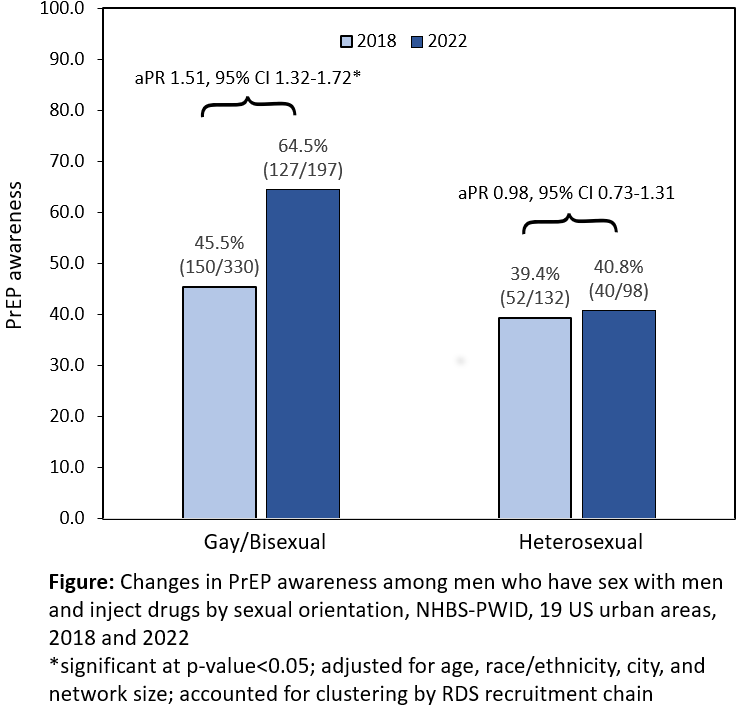
Of HIV-negative MSM-ID, 71.5% (331/463) in 2018 and 66.8% (197/295) in 2022 identified as gay/bisexual. Between 2018 and 2022, there was a significant increase in PrEP awareness among gay/bisexual MSM-ID (45.5% in 2018, 64.5% in 2022; aPR=1.51, 95% CI=1.32-1.72) but not for heterosexual MSM-ID (39.4% in 2018, 40.8% in 2022; aPR=0.98, 95% CI=0.73-1.31) (Figure). Among MSM-ID aware of PrEP, PrEP use was low in both years regardless of sexual orientation (gay/bisexual: 15.3% in 2018, 10.2% in 2022; heterosexual: 7.7% in 2018, 2.5% in 2022).
Conclusions:
The increase in PrEP awareness was limited to gay/bisexual men, however, PrEP use was low overall among MSM-ID regardless of sexual orientation. Without adequate HIV prevention, MSM-ID may be at risk of acquiring or transmitting HIV through injecting drugs and sex. Provider training may be useful to encourage assessment of both injection- and sex-related indications for PrEP during provider visits. Educational campaigns tailored to MSM-ID are warranted, particularly around risk behavior and benefits of PrEP regardless of one’s sexual orientation.