Background:
HIV-associated neurocognitive disorder (HAND) is a range of progressively severe central nervous system complications associated with HIV infection. The range can be from mild problems with memory, language, and reasoning to the more severe HIV-associated dementia. HAND has declined with the advancement of antiretroviral therapy (ART), however, remains prevalent in older people with HIV (PWH). We describe the prevalence of HAND among PWH among Medicaid enrollees in the U.S. from 2016-2021.
Methods:
We analyzed data from Truven Health MarketScan Claims and Encounters®, a large database derived from administrative claims for healthcare services provided to Medicaid enrollees. Among enrolled persons aged >18 years, we identified PWH with at least one inpatient or outpatient medical claim with an HIV and subsequent major to mild neurocognitive disorders (NDs) ICD-10-CM diagnosis codes. We used chi-square to compare PWH with an associated NDs diagnosis (HAND) to those without an associated ND diagnosis code (no-HAND) to investigate differences in HAND prevalence by age, sex, race/ethnicity, and by prescribed ART from 2016-2021.
Results:
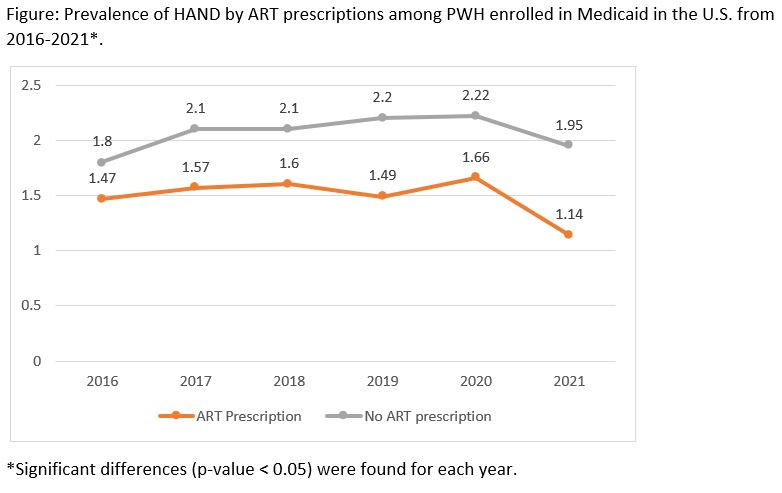
The annual crude prevalence of HAND ranged from 1.6% (512/31,897) in 2016 to 1.9% (558/29,967) in 2020. The prevalence of HAND significantly increased with age (p-value<0.001); highest prevalence was among ages 65+ years (range 3.7% in 2021;5.7% in 2017). Males had a significantly higher prevalence of HAND compared to females in 2016 (1.8% vs 1.4%; p-value= 0.007) and 2017 (1.9% vs 1.6%; p-value= 0.027) but from 2018-2021 there were no differences by sex. In 2016 and 2020 there were differences by race/ethnicity (p-value= 0.0002 and 0.001 respectively), with the highest prevalence of HAND among White persons in 2016 (1.9%) and Black persons in 2020 (2.1%) Among the 190,648 PWH from 2016-2021, the frequency of ART prescriptions ranged from 58% (18,671/31,897) in 2016 to 64% (21,018/32,820) in 2021. Prevalence of HAND was significantly higher among persons without an ART prescription (range 1.8% in 2016-2.2% in 2020) compared to those with an ART prescription (range 1.1% in 2021-1.7% in 2020) for each year (Figure).
Conclusions:
In this large administrative database of PWH, HAND remains persistent, with some demographic disparities. With the aging population of PWH, strengthening interventions that improve access to ART, promote adherence, and address barriers to clinical care and supportive services for PWH is critical for reducing health disparities.