The major hurdle to HIV-1 eradication is the establishment of viral reservoirs. CD8+TRM constitutively express cytotoxic molecules and their profile indicates that antiviral defense and target cell destruction represent key functions of these cells. Here we aimed to address the functional capacity of HIV-specific and non-specific CD8+TRM from the cervical mucosa in limiting HIV viral persistence.
CD8+TRM cells from cervical tissues were phenotyped by FACS (n=9). In ART-suppressed HIV+ women (n=8), we determined total vDNA in blood and cervix and its correlation with the frequency of cervical CD8+TRM, as well as Gag-specific CD8+TRM in cervical biopsies (n=7). A functional assay was established to assess suppression of reactivated CD4+T cells by cervical CD8+TRM from an ART-suppressed HIV+ woman undergoing hysterectomy. To evaluate non-specific natural capacity of CD8+TRM in limiting the reactivated viral reservoir, an ex vivo latency model using IL-7 was established using cervical explants from uninfected women. Natural cytotoxicity was measured by simultaneously determining p24 expression and cell-associated HIV-1 DNA in reactivated CD4+T cells in the presence or not of autologous CD8+TRM from uninfected tissue.
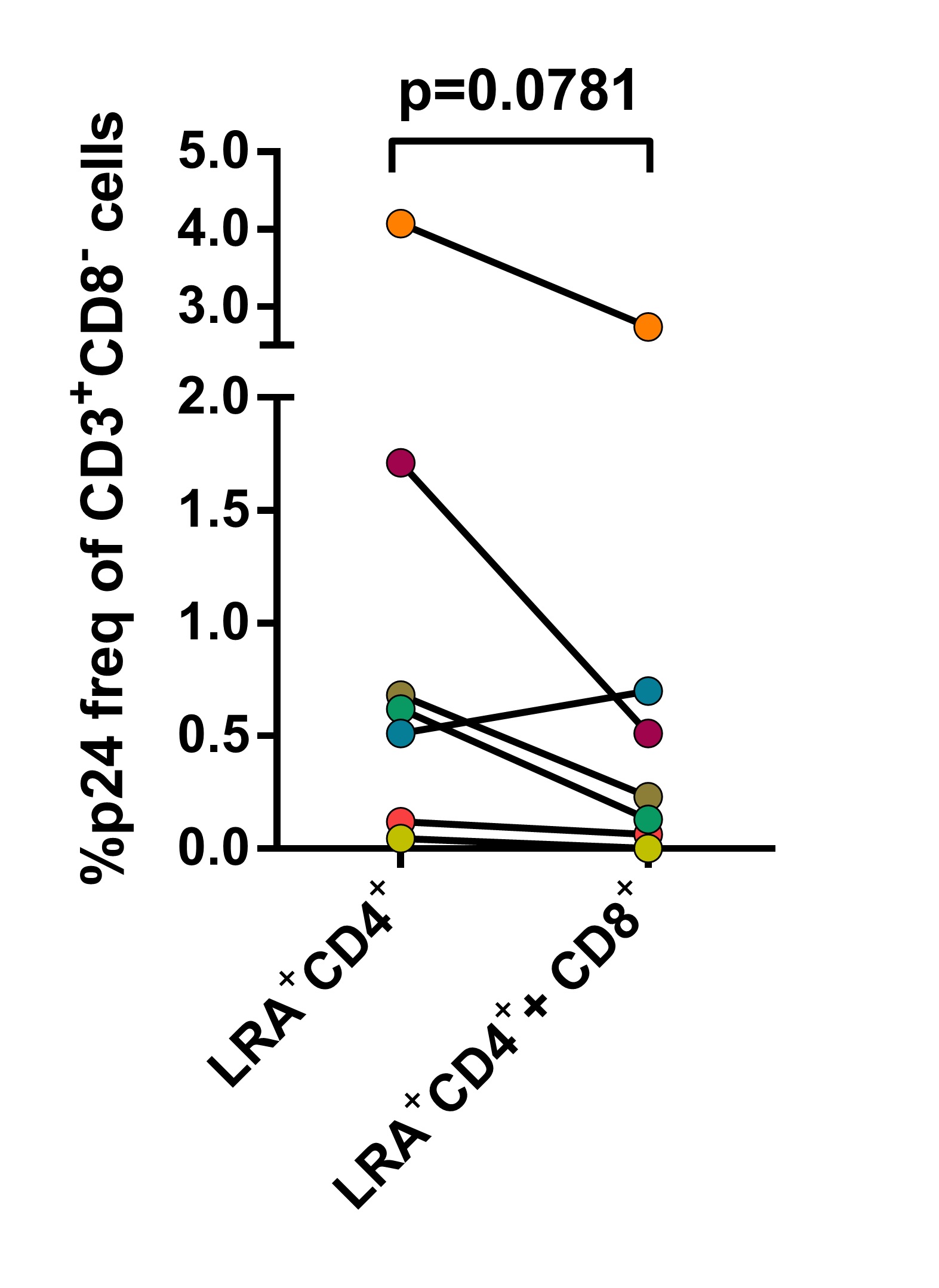
Cervical CD69+CD8+T cell profile was compatible with >90% belonging to bona fide TRM. Further, CD8+TRM in cervical tissue represented >90% of CD69+CD8+T cells, and cervical samples from ART-suppressed patients had higher frequencies of CD8+TRM (p<0.05) and non-TRM (p<0.01). The frequency of cervical CD8+TRM cells correlated with proviral HIV-1 DNA in cervix (n=7; p=0.03) and blood (p=0.05). Gag-specific CD8+TRM were rarely detected in biopsies, which was likely limited by sample size. Still, cervical CD8+TRM cells from the HIV-infected woman with a large sample were more efficient at eliminating HIV-reactivated CD4+T cells than circulating effector CD8+T cells. The latency model evidenced a natural capacity of CD8+TRM to reduce p24+ cells after reactivation (n=7; p=0.08; Figure), which, in cases of higher cell yield recovery, was associated with a decrease of the total reservoir size.
CD8+TRM in cervix are associated with less proviral HIV-1 DNA and may exert a greater control of the reservoir than effector circulating CD8+T cells. A cervical latency model could be crucial to study how HIV tissue reservoir could be eliminated not only by enhancing HIV-specific CD8+TRM but also by promoting their natural cytotoxicity.