Changes in the distribution of T cell subsets have been linked to prevalent diabetes in the general population. As persistent immune activation is a hallmark of HIV infection, we assessed whether T cell subsets were associated with incident diabetes in persons with HIV (PWH).
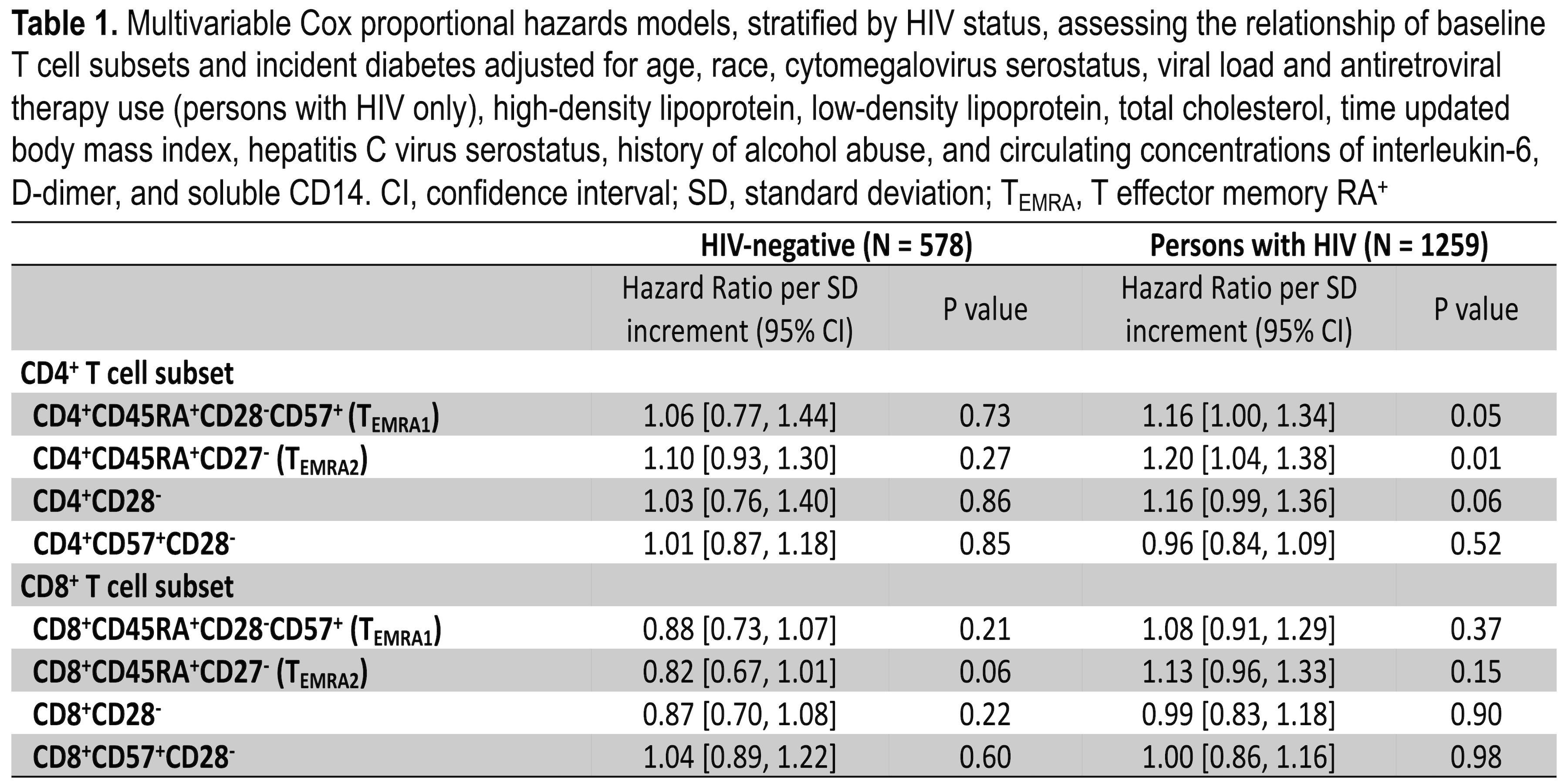
We performed flow cytometry and functional assays on peripheral blood mononuclear cells collected from PWH and HIV-negative participants in the Veterans Aging Cohort Study between 2005 and 2007 to characterize CD4+ and CD8+ memory (central, effector, and effector RA+ [TEMRA]), CD57+, CD28-, and TH1, TH2, and TH17 CD4+ T cells. We used two definitions of TEMRA cells: CD45RA+CD28-CD57+ (TEMRA1) and CD45RA+CD27- (TEMRA2) (Table 1). Cases of incident diabetes were identified by two-physician chart adjudication. Individuals were followed until the onset of diabetes, death or end of study. We assessed PWH and HIV-negative participants separately using multivariable Cox proportional hazards models with T cell subset as the main exposure adjusted for demographic variables, lipid levels, cytomegalovirus (CMV) and hepatitis c virus serostatus, alcohol use, circulating inflammatory markers, and viral load and antiretroviral therapy use (PWH only). We report the hazard ratio (HR) for incident diabetes per standard deviation increment in the T cell subset.
A total of 1259 PWH and 578 HIV-negative individuals were without diabetes at baseline and there were 238 incident diabetes events (133 [10.6%] in PWH and 105 [18.2%] in HIV-negative) over a median follow-up time of 8.6 years. The median age was 52 years, 69% were black, 95% were male, and 65% of PWH were virologically suppressed. In the adjusted model, a higher baseline proportion of CD4+ TEMRA cells, using both definitions, was associated with increased risk of incident diabetes in PWH only (TEMRA1 HR 1.16 [1.00,1.34]; p=0.05 and TEMRA2 HR 1.20 [1.04,1.38]; p=0.01) (Table 1). Higher proportion of CD4+ CD28- T cells approached significance in the model (HR 1.16 [0.99,1.36]; p = 0.06) in PWH only. A similar association was not observed for CD8+ TEMRA cells, and no T cell subsets were associated with risk of incident diabetes in HIV-negative individuals.
Higher baseline proportion of CD4+, but not CD8+, TEMRA cells was associated with an increased risk of incident diabetes in PWH. As diabetes is common in PWH, understanding the potential role of T cells may provide insight into prevention or therapeutic strategies.