Background:
Cabotegravir stearate (M2CAB) is a novel prodrug of the INSTI cabotegravir (CAB) that forms local and macrophage-distributed M2CAB depots, resulting in ‘flip-flop’ plasma pharmacokinetics (PK) yielding a protracted apparent elimination half-life. M2CAB is formulated as an extended-release injectable suspension (XVIR-110) for intramuscular (IM) administration that may achieve ultra-long-acting therapeutic CAB exposures with infrequent administration.
Methods:
We evaluated the PK profile of M2CAB and/or CAB in following a single IM (thigh muscle(s) of hind limb; 28 ga. syringe) administration of XVIR-110 to male SD rats and male beagle dogs. XVIR-110 was dosed at target M2CAB doses of 75, 185 (single and (2)-split injections) and 638 mpk (split injections) in rats and at 40 and 151 mpk in dogs. PK were assessed at multiple timepoints over up to 12 months until CAB concentrations fell to less than the protein binding-adjusted IC90 (PB-IC90) of 166 ng/mL. Drug concentrations were measured using validated UPLC-MS/MS methods. Additionally, a separate study of injection site reactions (ISR) with histopathologic evaluation of head-to-head administration of XVIR-110 and commercial cabotegravir was conducted in rats.
Results:
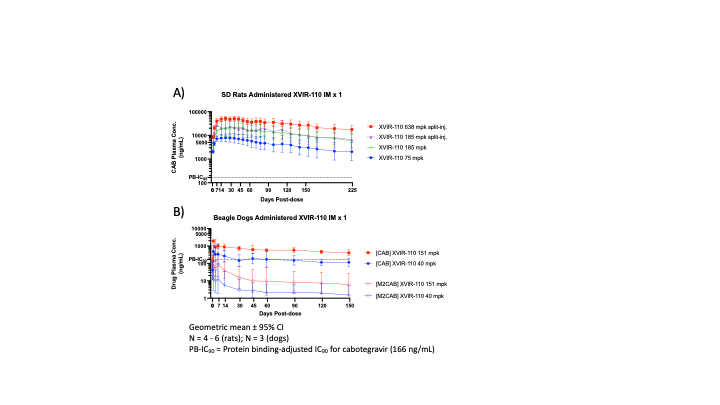
Concentration-time profiles are presented in Figure 1 for CAB in rats (Panel A) and for M2CAB and CAB in dogs (Panel B) below. A single IM administration XVIR-110 resulted in low exposures of the prodrug M2CAB but yielded high and persistent exposures of active CAB in both rats and dogs over the period of study to date, 7 and 5 months, respectively. The study is ongoing and based on the projected apparent terminal-elimination half-life of CAB, concentrations above the PB-IC90 of CAB are expected to remain for more than 12 months. Based upon modelling, these data suggest that XVIR-110 could be dosed once- or twice-yearly in humans. XVIR-110 was well tolerated without evidence for dose-limiting ISRs and demonstrated less pronounced early post-injection microscopic changes, including tissue necrosis, inflammation, and immune cell infiltration vs. commercial cabotegravir at equivalent doses.
Conclusions:
XVIR-110 demonstrated sustained CAB exposures and a favorable ISR profile in nonclinical species. As such, XVIR-110 may be ideally suited where daily, self-directed, or more frequent IM or SQ may be less desirable or feasible, particularly where inconsistent and/or ad hoc adherence is a risk, such as pre-exposure prophylaxis (PrEP) or in patients with known adherence challenges.