Background:
Cardiovascular disease (CVD) burden in transgender women (TW) may be affected by gender-affirming hormonal therapies (GAHT), HIV and antiretroviral therapy (ART), but few data exist comparing TW on contemporary GAHT and ART to well-matched controls. We compared CVD burden and sex hormone profiles between TW and matched cisgender men (CM).
Methods:
Adult TW on GAHT (n=31) were recruited from Houston, TX and Baltimore, MD for a cross-sectional study (2018-2020). CM (n=60) from the Multicenter AIDS Cohort Study were matched (2:1) to TW on HIV serostatus, age ±5 years, race/ethnicity, BMI category and ART type. All HIV+ persons had HIV-1 RNA < 50 copies/ml on ART. Subclinical coronary atherosclerosis was measured by computed tomography (CT) angiography. Serum was collected concurrent to CTs; sex hormone concentrations were measured centrally. Student’s t, Kruskal-Wallis or Chi-square tests compared groups; correlations were determined using Pearson or Spearman testing.
Results:
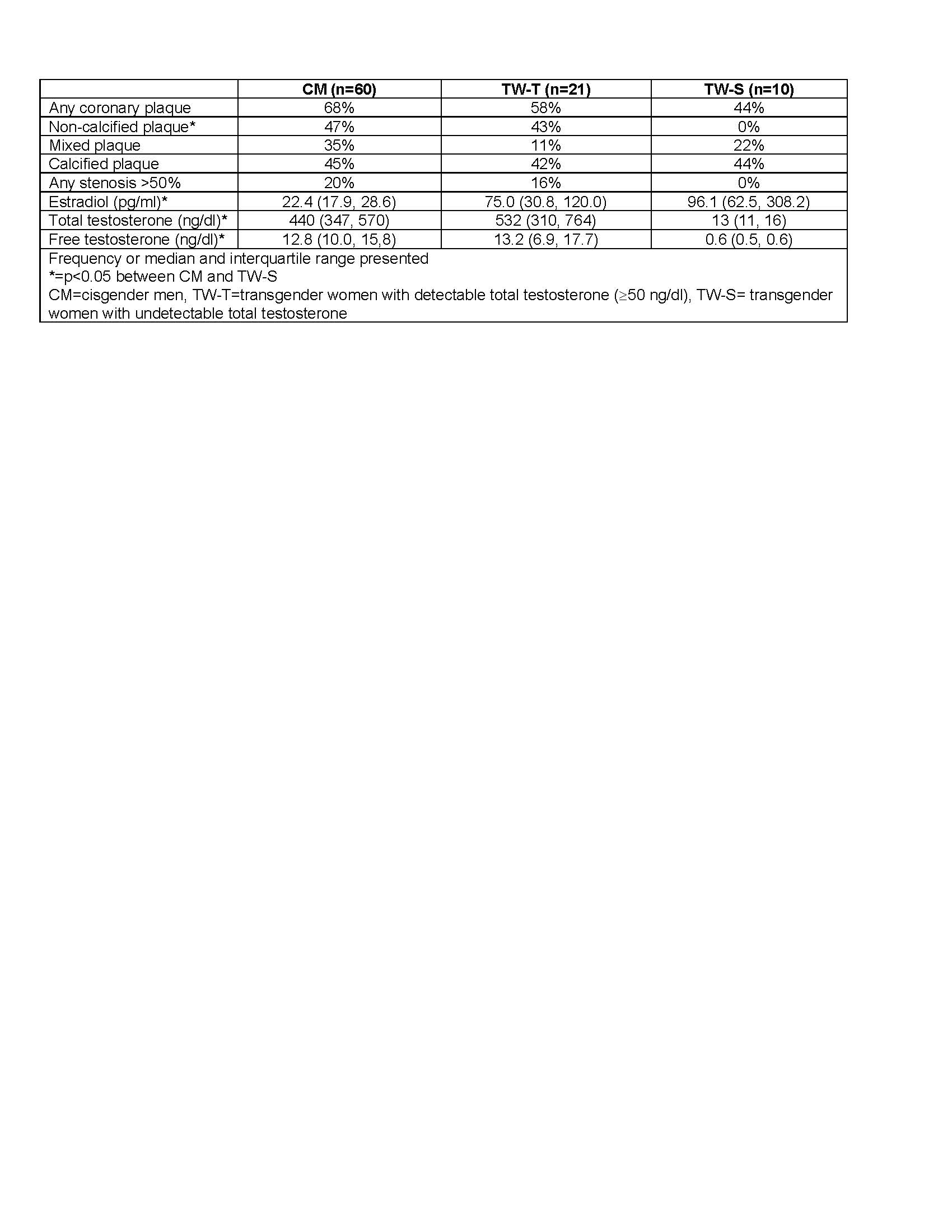
Overall, median age was 53 years and BMI 29 kg/m2; 73% were non-white and 75% HIV+. Only 31% of TW had testosterone suppression ( < 50 ng/dl, TW-S). Traditional CVD risk factors were similar, except that the subset of TW-S had higher BMI (34 kg/m2) than TW with detectable testosterone (TW-T) and CM. Compared to CM and TW-T, TW-S with and without HIV had similar prevalences of calcified and mixed plaque, but none had non-calcified plaque or stenosis >50% (Table). Estradiol but not T correlated with mixed plaque (r=0.27, p < 0.01) and total plaque and total stenosis (both r=-0.21, p=0.05).
Conclusions:
In older TW with suppressed total testosterone on GAHT, no non-calcified coronary plaque or advanced stenosis was observed, while CM and TW with detectable testosterone had equivalent subclinical CVD burden. Observations occurred independent of HIV serostatus and despite similar traditional CVD risk factor profiles to CM and more obesity among TW with suppressed testosterone. Longitudinal studies to understand relationships between GAHT and CVD risk in TW are needed.
Coronary plaque and stenosis burden and sex hormone concentrations.